
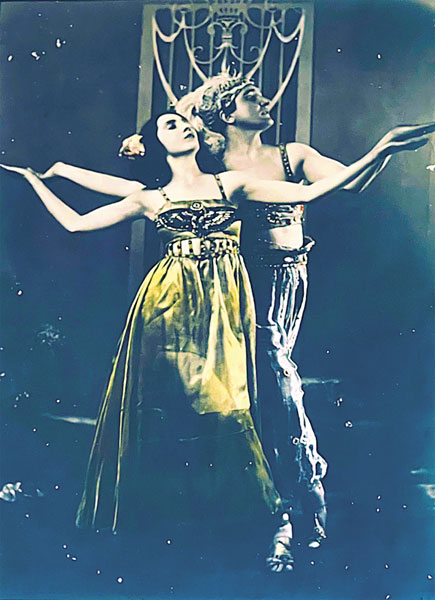
A new community-funded mural at Ajijic’s cemetery will honor one of Lakeside’s most unforgettable figures: Zara Alexeyewa, affectionately known as “La Rusa,” The Russian. Created in partnership with the Municipality of Chapala, the mural is slated for completion on August 11, celebrating what would have been her 130th birthday.
“It is more than a work of art. It is an act of remembrance — a way for this community to restore the honor that history failed to preserve,” says Alberto Portillo, Chapala’s Director of Archives.
Born Eleanor Saenger in Brooklyn, New York in 1896, La Rusa lived a life that seems almost impossible today. She was an actress, ballet dancer, author, adventurer, gold prospector, environmental activist, and tireless champion of Lake Chapala.
The only child of Oscar Saenger, a baritone singer and voice coach, and Charlotte Wells Saenger, a prominent organist, Eleanor was pampered and privileged from birth. She began ballet lessons at age six and made her first professional stage debut at nineteen, performing under the name Khyva St. Albans.
Her father bankrolled many of her early shows, much to the family’s financial ruin. One Broadway production alone was financed to the tune of $43,000 (the equivalent of $750,000 today) and her wardrobe was valued at $25,000. She traveled with a maid, a companion, and two cars at her disposal.
After modest success in the United States, Eleanor and her mother headed to Europe, where performances of The Painted Laugh at London’s Garrick Theatre ended in disaster. When the show flopped, they fled without paying the cast or backers. Scotland Yard launched a search, but it was the paparazzi who found Zara first, hiding out in a fashionable Paris hotel.
It was in Berlin that her life took its most defining turn. There she met Holger Karl Mehnen, a dashing Danish ballet star from Copenhagen who had trained at the Royal Danish Ballet School. His electrifying performances were favorably compared to those of the legendary Nijinsky.
The two became inseparable artistic partners and soulmates and began billing themselves as Russians. She claimed to be the daughter of Prince Alexei Pavlovitch, adopting the name Ayenara Zara Alexeyewa. He became Holger Alexeyev Mehner.
Author Tony Burton, who writes extensively about Zara in his book Foreign Footprints in Ajijic, describes her as “a biographer’s worst nightmare because she used some twenty different names throughout her lifetime and regularly reinvented her past.”
The two dancers successfully toured Europe and South America for over three years, and in 1924, accompanied by Zara’s mother, they arrived in Guadalajara. While preparing for a show at the Degollado Theatre, they rented the charming Villa Reynera on the shores of Lake Chapala.
Zara fell in love with Mexico, calling it her true home. Inspired by the landscape and culture surrounding her, she wrote two original ballet performances: Princess of the Moon and Nauollin. On the advice of a clairvoyant, she also invested in Ajijic gold mines.
On February 16, 1926, Holger and Zara made their American debut at the Metropolitan Opera House in New York and were subsequently offered a multi-year contract with the Philadelphia Grand Opera Company. Their star was rising.
Meanwhile, Zara’s father Oscar had become a devoted follower of the Indian yogi Paramahansa Yogananda, founder of the Self-Realization Fellowship, who lived for a time in the Saenger family’s New York brownstone. When Oscar died of cancer in 1929, Yogananda performed Hindu rites at his funeral — much to the consternation of the Jewish relatives present. It was then that Zara extended an invitation for the Swami to visit Mexico.
Stopping first in Mexico City, Yogananda met President Emilio Portes Gil, who became a dedicated admirer of his philosophy. In Chapala, Zara, Holger, and Charlotte entertained their esteemed guest lavishly. He attended one of their performances at the Degollado Theatre, rode horseback with them along the lakeshore to visit a gold mine, and during a boat trip to Tizapan el Alto, an iconic photograph was taken of him standing aboard a traditional sail canoe.
Zara’s personal life, however, was soon marked by profound hardship. In 1936, while in Guadalajara, Holger suffered a devastating accident — pinned between a car and a lamp post. Miraculously, he performed two nights later, but it was the last time he and Zara would ever dance together. He eventually lost the use of his legs and, wheelchair-bound, descended into a life of drinking, gambling, and hypnotism.
Zara cared for him as he declined, until his death on August 10, 1944, in a Guadalajara nursing home, just shy of his fiftieth birthday. He is buried in the Ajijic cemetery. She had little time to mourn, however, as she was simultaneously caring for her mother, who had dementia. Charlotte passed away in 1949 and is interred beside Holger.
In the years that followed, Zara channeled her grief into writing. Under the pen name Frances De Brundige, she produced Quilocho and the Dancing Stars, a 415-page semi-fictional autobiography recounting her adventures with Holger in Mexico — including a remarkable episode in which a man named Quilocho Retolaza, a former officer of Pancho Villa, helped Zara escape capture when bandits attempted to ransom her for gold.
Perhaps her most enduring legacy was her fierce and visionary defense of Lake Chapala. By the mid-1950s, a severe drought had pushed the lake to the verge of collapse. Engineers proposed filling in a large portion of its eastern side and removing some 180 square kilometers of water. With the government poised to act, Zara and fellow residents formed the Committee for the Defense of Lake Chapala.
Adding to the problem, a hydro-electric power plant at El Salto was extracting water from the lake to supply electricity to Guadalajara but was unreliable. In a bold move, she made a direct appeal to U.S. President Eisenhower, invoking the Good Neighbor Policy. A month later, the U.S. consul announced that a 10,000-kilowatt diesel-electric locomotive (essentially a massive mobile power plant) had been placed at the service of the Jalisco state government, relieving pressure on the lake.
In the 1960s, she campaigned for a water treatment plant in Chapala as pollution from untreated sewage worsened. In the 1980s, she helped convince officials to build the La Zurda dam and reservoir to protect the lake from over-extraction.
An expert equestrian, Zara continued to ride — and to perform — well into her eighties.
“I was just ten years old when I saw this exotic woman dressed all in black, speeding on horseback across the cobblestone streets of our village,” recalls Hector España Ramos of Ajijic’s Manix II Restaurant Bar.
“My mother and La Rusa were good friends and they worked together. They did a lot for this community.”
Hector’s mother, Julia Ramos Velasquez, was a Regidora, a city council member. When Hector served as Delegado de Ajijic from 2013-2015, he spearheaded an effort to restore La Rusa’s gravesite at the Ajijic cemetery.
La Rusa lived to the age of 92. Her last wishes were that her home become a museum, a place where her memorabilia could be enjoyed by the public. It was not to be. As her cognitive abilities declined, those entrusted with her care and estate took advantage of her. Important records disappeared. Her property was lost. One of Ajijic’s great historical figures died in poverty, her wishes unfulfilled.
Yet her spirit never disappeared. Today, traces of La Rusa remain throughout Ajijic — in stories passed from one generation to the next, in the legacy of her environmental battles, and in the cemetery where she rests beside those she loved. A ceramic nameplate still marks her former residence, Casa de la Rusa, at 26 Independencia. Oil paintings of Zara and Holger in costume hang in the restaurant of Hotel La Nueva Posada at Donato Guerra 9.
Now, at last, a mural will ensure that future generations know of the remarkable woman who gave so much. It is the memorial she always deserved.
For more information on the La Rusa Mural Project or to lend support, visit: spot.fund/TheLaRusaMural

 Discover trusted local services and hidden gems with our easy-to-use online directory.


- The Legendary Life of La Rusa - July 30, 2026


colorful and conflicted woman. hope to see her mural one day. well written tribute which she would love.
When my husband and I first came to Ajijic in 2009, we started looking for a place to buy and got to see inside La Rusa’s turquoise colored casa on Independencia. Our Mexican property manager remembered, when he was a boy, seeing La Rusa, always dressed in black, riding her black horse, stopping outside various tiendas, and without dismounting, placing her order with the shopkeeper, to be delivered later. I was given her semi-fictional autobiography “Quilico and the Dancing Stars” and, as a former professional ballet dancer myself, was intrigued by the memoir of someone who seemed larger than life. But then there are some people who are larger than life.