The Blue Robe Mystery
The rabbit hole started with a hangover in Barcelona.
A small, brown-robed friar appeared on the nightstand accompanied by a voice on high. “Hair of the dog?” The voice asked.
The voice belonged to my cousin, Wayne. The monk was a bottle of Frangelico.
The bottle is shaped like a Franciscan friar, complete with a knotted rope around its center meant to represent a monk’s cincture. The trademarked container honors the creator of many early hazelnut liqueur recipes, Fra’ Angelico, a 15th century Dominican friar from Italy.
After accepting my cousin’s kind offer and coming a bit back to life, I remembered a stray comment a neighbor from Chapala tossed out once when we were watching the patron of Chapala’s main church, San Francisco, make his annual pilgrimage from the altar to the shore of the lake on the shoulders of local costaleros.
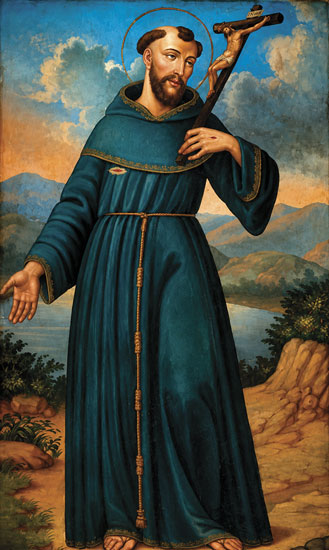
“Franciscan monks used to wear blue robes.” I told my cousin.
The idea had seemed surprising when I first heard it. And repeating it now made me wonder (again) why an order grounded in humility and poverty had chosen blue robes. It turns out that not only was indigo dye widely available in pre-Hispanic Mexico, but the color has a significant place in the cosmology of many, if not most, indigenous cultures here.
The friars who adopted blue appear to have done so in honor of the Virgin Mary. Yet they entered a landscape where blue had been sacred for centuries and those blue robes certainly lent an air of holy authority to their message. Whatever the friars intended, Indigenous communities were never simply passive recipients of the new faith. They interpreted it through the lens of their own beliefs, preserving their culture while adapting to a rapidly changing world.
Nowhere is that more evident than in the Mexican feast day celebrations of Catholic saints. The holy feast day of Chapala’s patron saint, San Francisco, is October 4th but the celebration starts nine days before on September 26th. Saint Francis may have arrived from Italy by way of Spain, but the festival that celebrates him has become unmistakably Mexican.
Indigenous ceremonial dance survived as an act of devotion, with feathered danzantes offering prayer through movement much as their ancestors had long before the arrival of the Spanish. Processions transformed church ritual into something equally at home in the streets and public squares, echoing older traditions of carrying sacred images through the landscape. The fragrance of copal incense, used for centuries in Indigenous ceremonies, now mingles with Catholic prayers. Music, flowers, and communal feasting, elements deeply rooted in pre-Hispanic ceremonial life, remain as central to the celebration as the Mass itself.
The festivities of San Francisco in Chapala may not look much like the Catholicism your grandmother knew, but they’re joyful, colorful, occasionally chaotic, and gloriously alive. The celebration belongs to neither Spain nor pre-Hispanic Mexico alone. It is the product of five centuries of adaptation, resilience, and faith. Like the blue robes that first sent me down this rabbit hole, it reminds us that history is rarely straightforward. The festival is a reminder that while history can alter a people forever, it cannot extinguish their instinct to remember, celebrate, and belong.

 Discover trusted local services and hidden gems with our easy-to-use online directory.


- Editor’s Page – October 2026 - September 30, 2026
- Good Works Gazette – September 2026 - August 29, 2026
- Editor’s Page – September 2026 - August 28, 2026