In the early twentieth century, women who pursued careers in science faced enormous institutional barriers. Universities, scientific societies, and research institutions routinely excluded them or treated them as outsiders. Against this difficult backdrop, two remarkable women—Marie Curie and Hertha Ayrton—formed a profound friendship built on mutual admiration, shared grief, and a determination to see women receive the recognition they deserved. First meeting in London in 1903, they shared an instant, deep empathy that would later save Curie during one of the greatest personal and professional crises of her life.
Marie Curie was already internationally famous by the early 1910s. Alongside her husband, Pierre Curie, she discovered the elements polonium and radium, transforming the study of radioactivity. Following Pierre’s tragic death in a street accident in 1906, Marie continued their pioneering work, becoming the first woman to teach at the Sorbonne in Paris. In December 1911, she accepted her second Nobel Prize, this time in Chemistry, making her the first person ever to win Nobel Prizes in two different scientific fields.
Hertha Ayrton, an exceptional British engineer, mathematician, and inventor, was a formidable force in her own right. She made groundbreaking contributions to the understanding of electric arcs and the movement of ripple marks in sand and water. Hertha was the first woman to read her own paper before the Institution of Electrical Engineers, which awarded her the prestigious Hughes Medal in 1906.
Yet, like Marie, she constantly struggled against a patriarchal scientific community. Hertha famously faced rejection from the Royal Society because, as a married woman, she legally had “no existence” under British law. Having also lost her husband in 1908, Hertha intimately understood the crushing weight of early widowhood and institutional sexism. When critics tried to claim Marie’s discoveries belonged entirely to Pierre, Hertha fiercely defended her friend in the British press, dryly writing, “An error that ascribes to a man what was actually the work of a woman has more lives than a cat.”
The true test of their bond came between 1911 and 1912. Just as Marie was securing her historic second Nobel Prize, her triumph was completely overshadowed when the French press discovered her romantic relationship with Paul Langevin, a married physicist and former student of Pierre. Xenophobic and misogynistic tabloids sensationalized the affair, branding the foreign-born Marie a homewrecker.
An angry mob even surrounded her house, threatening her young daughters. Exhausted by public hostility, physically ill from a kidney condition, and deeply depressed, Marie withdrew entirely from public life.
Outraged by the blatant sexism—noting that male scientists escaped similar scrutiny regarding their private lives—Hertha stepped forward to offer a lifeline. Through warm, practical letters, she urged Marie not to let public gossip diminish her confidence or distract her from her scientific work. Hertha reminded Marie that her true value lay in her discoveries and her integrity, not in newspaper headlines.
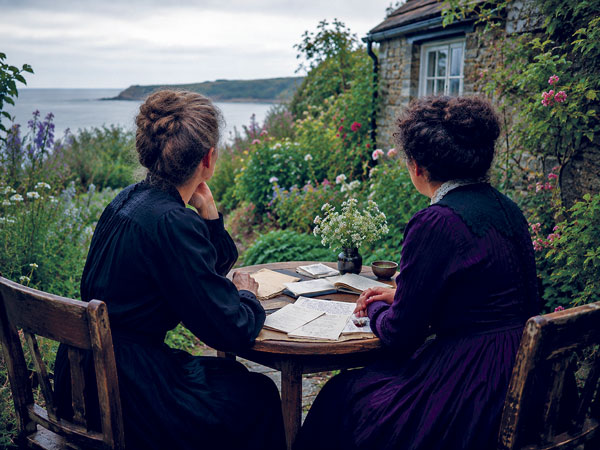
Hertha soon took decisive action. In the summer of 1912, seeing her friend hunted by paparazzi and collapsing under stress, she secretly arranged for Marie to escape France. To evade predatory journalists, Marie traveled to the English coast under her maiden name, Sklodowska.
Hertha rented a quiet, secluded house called Highcliffe in Dorset to create a safe haven. There, Marie was joined by her daughters, fourteen-year-old Irène and seven-year-old Ève, as well as Hertha’s daughter, Barbara, a fierce suffragette who had recently been jailed for political activism. The summer retreat became a restorative blend of motherhood, intellectual companionship, and healing. While Marie rested and focused on her health, Hertha took Irène under her wing, teaching her advanced mathematics. In the evenings, Hertha played the piano while little Ève sang.
The protective care worked. By October 1912, the public furor in Paris began to quiet down, and a rejuvenated Marie returned to France. In December of that year, she made her first entry in her laboratory notebook in nearly fourteen months, ready to work again.
Their friendship endured until Hertha’s death in 1923. While history often paints Marie as a solitary, tragic genius, her survival through her darkest year stands as a testament to the resilient power of female solidarity.
Today, American playwright Lauren Gunderson’s acclaimed The Half-Life of Marie Curie brings this inspiring historical chapter to the stage with wit and humanity. Since its 2019 Off-Broadway debut, the play has explored not only Marie’s scientific achievements but also her personal struggles and the healing power of friendship. Bravo Theatre presents the production this October.
Sharon Jarvis spent her adult life as a theatre professional. First as an actress and laterally as a theatre manager and administrator. During her eight years at Lakeside, she has participated in productions at each of the community theatres here.

 Discover trusted local services and hidden gems with our easy-to-use online directory.


- A Friendship Forged in Science and Equality - August 29, 2026