
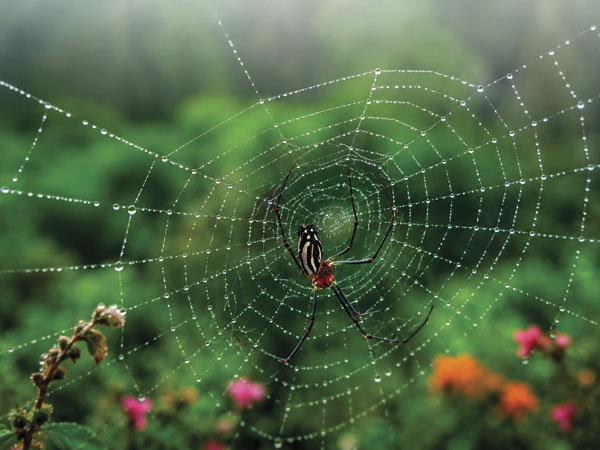
“Is there anything in the universe more beautiful and protective than the simple complexity of a spider’s web?” – E.B. White
In the summer of each year, after the hard rains have replenished the landscape, I notice a menagerie of large, vibrantly colored adult orb-weaver spiders emerging in my backyard. There are several varieties, including the enormous golden silk orb-weavers, the silver Argiope with its spiky body and fluorescent web decorations, and the stunning orchard spider. Each has claimed a spot that they consider prime real estate for capturing flying insects.
These colorful spiders are members of the family Araneidae, considered the master architects and trappers of the spider world. Their webs are the iconic, symmetrical, wheel-shaped (orb-like) webs overlaid with a sticky spiral that we generally think of as spider webs. Beyond their aesthetic beauty, orb webs are complex, technological marvels. Constructed with virtually invisible strands of silk thinner than a human hair, they are durable, sturdy, and stretchy enough to absorb the impact of a large insect in full flight.
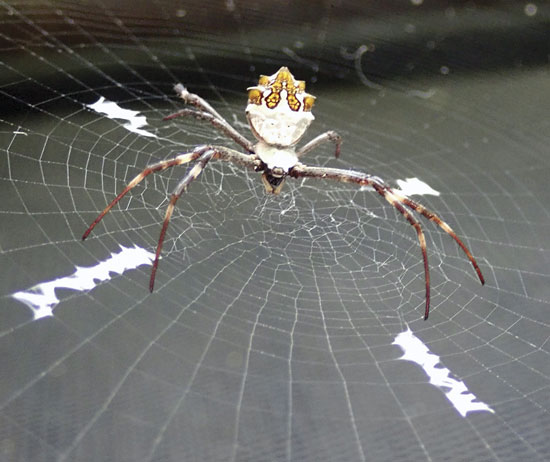
While their distant spider cousins rely on extremely potent venoms, camouflage, or ambush tactics, orb-weaver spiders rely on the efficiency of their webs to capture a wide variety of prey, including mosquitoes, flies, beetles, wasps, and moths. They take meticulous care of their webs, sometimes even consuming their handiwork during the night and rebuilding from scratch in the morning.
You might think that mastering the skillset to construct such complex webs would take months or even years of learning and practice, but orb-weaver spiders don’t have that luxury. They have a short, one-year life cycle and begin life as orphans. Throughout the spring, they emerge, along with hundreds of their spiderling siblings, from cream-colored, silken egg casings that have kept them alive through cold winter nights. Their mothers do not survive the winter months. Their much smaller fathers fare much worse, often getting consumed by their partners after mating.
After making a mad dash to escape their cannibalistic siblings, they find an ideal spot to trap flying insects and immediately begin creating a spider web masterpiece. Despite never having seen a spider web, they can construct a miniature version of their species’ signature web on their first attempt. This is quite a feat for an animal with a brain that is roughly the size of a poppy seed.
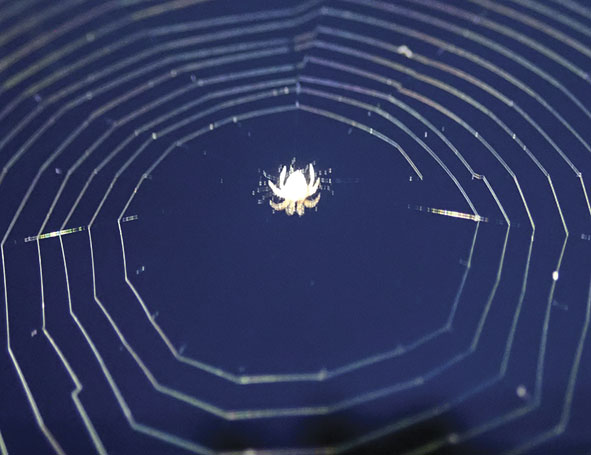
Figuratively speaking, this is all done with species-specific, instinctual blueprints encoded into the spiders’ DNA. These blueprints are ancestral legacies, over 140 million years in the making, that continue to evolve. At a macroscopic level, web construction is carried out through an elaborate orchestration of four distinct stages: bridge line and frame construction, placement of radii (spokes), construction of an auxiliary spiral (temporary scaffolding), and laying the capture spiral. However, the spider does not need to visualize its web while performing this work.
Within each stage, they execute their blueprints through repeated sequences of brief movements that ethologists refer to as fixed action patterns (FAPs). These are unlearned, genetically hardwired behaviors that, once triggered by specific internal or environmental cues, run to completion. These are the elemental building blocks from which complex innate behavior can be composed. For example, during construction, a spider will continually perform “leg sweeps,” sweeping its legs across newly laid silk threads, allowing them to precisely “feel” the web’s structure and density. As another example, spiders repeatedly use their bent legs as calipers to place sticky spiral threads at precise widths.
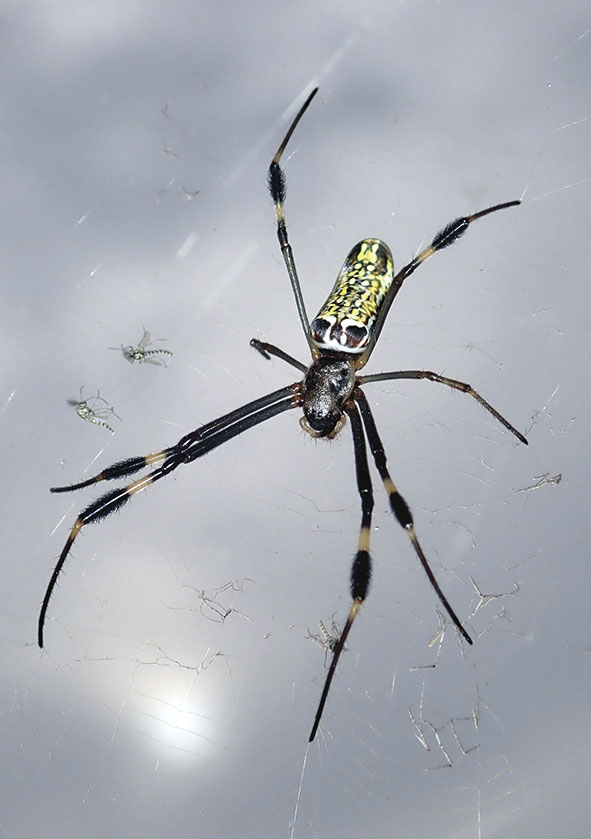
Web building is not entirely reflexive or automatic; orb-weaver spiders do have some autonomy and flexibility in the process. This “behavioral plasticity” allows the spider to make real-time adjustments to correct errors or adapt to environmental changes. This also enables innovation and provides an evolutionary pathway through a process called “genetic assimilation.” For example, more adaptable spiders might adjust web spacing based on prey size or add defensive elements to counter new predators. Over generations, natural selection locks any beneficial, once-learned behavior into the genome as an instinctual response.
In this way, the instinctual blueprints of spider webs have evolved over 140 million generations of spiders. The history of orb-weaver spiders is “interwoven” with that of flowering plants and pollinating insects such as bees and butterflies. It’s hard to imagine a world without colorful flowers, but flowering plants did not exist on our planet until about 140 million years ago. As flowering plants drove the evolution of new flying insects, enterprising ancestors of today’s orb-weaver spiders must have taken notice and learned how to weave crude orb webs to capture the plentiful pollinators safely.
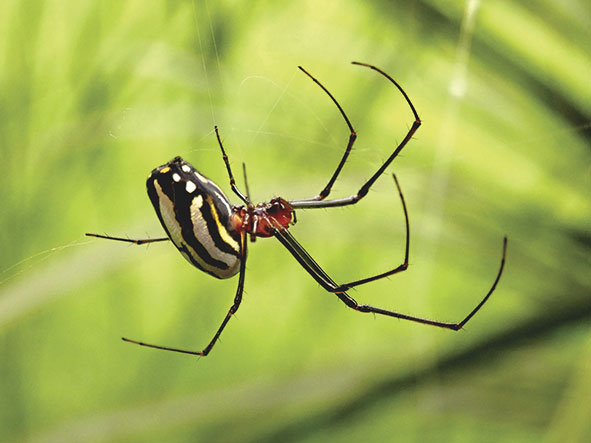
Over millions of years, the spiders and pollinators have engaged in evolutionary one-upmanship, gradually pushing each other to become better versions of themselves. For example, butterflies have developed detachable scales that enable them to escape from sticky spider webs. Similarly, silver Argiope spiders have developed fluorescent bodies and web decorations (stabilimenta) that mimic the UV-reflective patterns in flowers. This helps them lure pollinators that rely on UV light to find flowers and nectar.
This year, I look forward to greeting the fourth generation of descendants of the wonderful orb-weaver spiders that I first met after moving to Mexico. I will wish them a successful year of trapping and mating. With any luck, they will endow their offspring with ever-so-slightly improved versions of their ancestral blueprints.

 Discover trusted local services and hidden gems with our easy-to-use online directory.


- The Ancestral Blueprints of Spider Webs - August 30, 2026
- Iridescence: Nature’s Light Show - April 30, 2026
- The Cataclysmic Origin Story of Leafcutter Ants - March 31, 2026


Cool!