
What the Hell Is All That Noise?
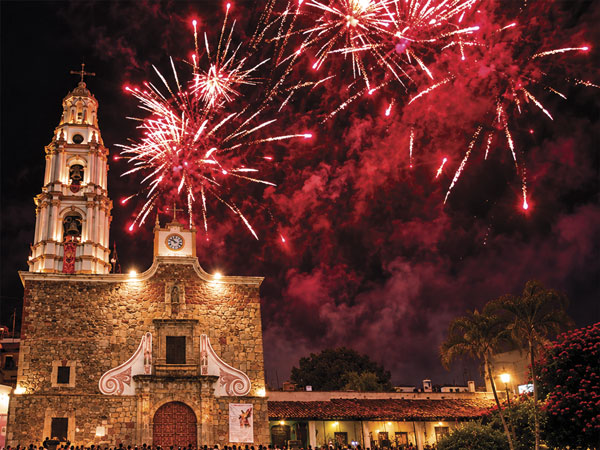
Sometime before dawn in late November, there will be a tremendous BOOM over Ajijic. Dogs will bark. The newly arrived will bolt upright wondering what exploded. Some longtime foreign residents will lie in bed composing angry Facebook posts in their heads. And somewhere an Ajijicense will probably roll over and think, San Andrés. The annual fiestas honoring San Andrés Apóstol, Ajijic’s patron saint, are upon us.
The cohetes are perhaps the most notorious part of the celebration, particularly among those of us who did not grow up believing that 5:30 in the morning is an entirely reasonable time to detonate explosives in honor of a saint. But before deciding what we think of all that racket, it’s worth asking: What exactly are we hearing? A very old tradition as it turns out.
Documents in Chapala’s municipal historical archive show that Ajijic was celebrating San Andrés by at least 1866 with cohetes, bulls, chirimías (traditional wind instruments), dawn celebrations and processions. People came from surrounding communities to join the festivities. And there were gremios.
A gremio is essentially a guild, a group united by occupation or trade. For generations, Ajijic’s celebration of San Andrés has been divided among these groups. Bakers, merchants, musicians, construction workers, gardeners, and others take responsibility for particular days of the nine-day celebration, contributing money and labor for flowers, Masses, processions, music, fireworks and other festivities. Think of it as an annual roll call of the working pueblo: “Today is our day. We are the bakers. We are the albañiles. We are the musicians. We are part of Ajijic, and today we honor our patron.”
Which raises another question: Who exactly is this fellow everyone has been making so much noise about?
Andrew was a fisherman. According to the Gospels, Andrew and his brother Simon Peter were casting their nets into the Sea of Galilee when Jesus called them. Peter went on to become the towering figure, the rock upon which the church would be built. Andrew remained the less celebrated brother, still strongly identified with the ordinary trade he practiced before becoming an apostle.
He could hardly have ended up in a more appropriate place. Ajijic was historically a fishing community, its life and livelihood intimately connected to Lake Chapala. It is tempting to imagine that this is precisely why Andrew became its patron, but history gives us a bit of a different story.
The seventeenth-century Franciscan chronicler Fray Antonio Tello wrote that the convent established at Axixic in 1531 was originally dedicated to San Francisco. Later, according to Tello, a friar named Andrés, particularly devoted to Andrew the Apostle, changed the dedication from the founder of his own Franciscan order to his favorite saint. Whether Fray Andrés considered Andrew’s former occupation, Tello doesn’t tell us. But through intention or happy accident, a fishing village got a fisherman for its patron.
More than three centuries after the Franciscans arrived, the people of Ajijic were celebrating San Andrés with many of the same ingredients we recognize today: tradespeople organizing themselves into gremios, processions through town, music, early-morning celebrations, bulls and, yes, cohetes. All of this 160 years ago.
Think how much Ajijic has changed since then. Fishing no longer dominates village life. Agriculture has receded and more foreigners have arrived. Tourism reigns as a major economic force. The village has become more of a town and real estate has boomed. English has become commonplace in the streets. The occupations represented by the gremios themselves have changed.
And still, every November, Ajijic does something its people were doing when Benito Juárez was fighting to restore the Mexican Republic. They gather by guild. They carry San Andrés through the streets. They play music. They celebrate. And they make one heck of a lot of noise.
You don’t have to enjoy being awakened by a cohete to understand that the explosion is saying something crystal clear: We are still here.

 Discover trusted local services and hidden gems with our easy-to-use online directory.


- Editor’s Page – November 2026 - October 29, 2026
- Editor’s Page – October 2026 - September 30, 2026
- Good Works Gazette – September 2026 - August 29, 2026