Of Virgins, Miracles, and Mass Production
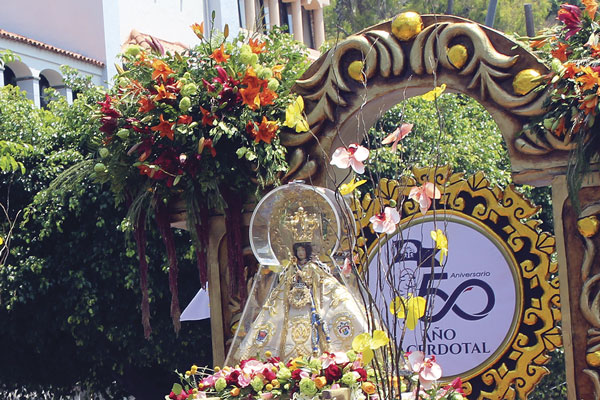
The first time I saw the Virgin of Zapopan ten years ago, I confess I was underwhelmed. Her elaborate gown was impressive, but her European-looking face and tiny stature reminded me of a mass-produced doll. The only Mexican Virgin I knew then was Guadalupe, with her distinctly Indigenous features and supernatural origin story. I soon learned there are hundreds, if not thousands, of venerated Virgins in Mexico. Jalisco alone has more than 70.
The Virgin of Zapopan, whom I’ve now encountered several times during her visits to Lake Chapala, has an ordinary origin and an esteemed history. Her original statue, barely a foot tall, was fashioned from cornstalk paste and an orchid-derived adhesive by Indigenous artisans in Michoacán nearly 500 years ago. Carried by a Franciscan missionary during the colonial period, she eventually became known as La Pacificadora, the Peacemaker. Today, the fragile original generally remains in Zapopan while traveling replicas visit communities around Jalisco.
In Mexico, even the humblest religious images can acquire extraordinary histories. The Virgin of Talpa, housed in the mountain town of Talpa de Allende, has inspired generations of pilgrims who walk long distances to reach her sanctuary. She has an extraordinary origin story. When a badly deteriorated statue was ordered buried in 1644, an Indigenous woman preparing it for disposal reportedly witnessed a burst of light. According to legend, the crumbling figure was instantly renewed, its fragile cornstalk-paste body transformed into solid wood. Thus, a statue deemed unworthy of devotion became the centerpiece of one of Mexico’s great pilgrimages.
The Virgin of San Juan de los Lagos, another small colonial-era image made using Indigenous techniques, became famous following a 17th-century account of a child miraculously restored to life. But it was the scene outside her basilica, rather than the miracle attributed to her, that initially left the strongest impression on me.
During a visit to San Juan de los Lagos, I wandered through streets lined with vendors selling religious images. There were statues, rosaries, candles, crucifixes, and seemingly endless variations of the baby Jesus. One table displayed hundreds of inexpensive plastic figures of the Christ Child, almost all with pale skin, and one solitary Black baby Jesus. The sheer scale of the commerce troubled me. Vendor after vendor, stall after stall, all selling objects associated with faith. It was difficult not to wonder where devotion ended and marketing began.
Yet, stepping inside the basilica was an entirely different experience. The commercial bustle gave way to an unmistakable sense of wonder. Generations of pilgrims had brought their hopes, grief, gratitude, and prayers to this place, and somehow their devotion seemed palpable. I felt it in Talpa, too. And in the churches where I’ve encountered other revered images of Mary and Jesus. Whatever my reservations about the commerce outside, I couldn’t dismiss what I experienced inside. I was raised Catholic-ish, so perhaps I’m particularly susceptible to religious splendor. Stained glass, vaulted ceilings, candles, all of these things were designed to inspire awe, and they often succeed. But what I felt went beyond the architecture and ornamentation. It seemed to arise from the devotion itself.
Catholic teaching makes an important distinction: believers do not worship the statues themselves. They venerate Mary and the saints represented by those images, while worship is reserved for God. The physical figure provides a focus for prayer and a tangible connection to the sacred. But that leaves me with a question. Does an object become sacred through what it is, what it represents, or the love and devotion people give it?
I’ve long believed that the grass is greener where you water it. Perhaps something similar happens with sacred places and objects. People bring their pure and sacred energy to these small figures. They dress them, adorn them with flowers, hoist them upon their shoulders and parade them through their communities. Whatever the source of holiness, the devotion is real. And perhaps the spiritual power I sensed in those churches came, at least in part, from the accumulated love of countless people who had been there before me.
I don’t know whether a statue can be holy. But I’ve come to believe that the human capacity for devotion is something sacred in and of itself. When the Virgin of Zapopan visited Lake Chapala this October, I still saw that tiny, doll-like figure beneath her magnificent finery. But I also saw something I missed the first time: the centuries of human love that surround her.

 Discover trusted local services and hidden gems with our easy-to-use online directory.


- Editor’s Page – December 2026 - November 27, 2026
- Editor’s Page – November 2026 - October 29, 2026
- Editor’s Page – October 2026 - September 30, 2026