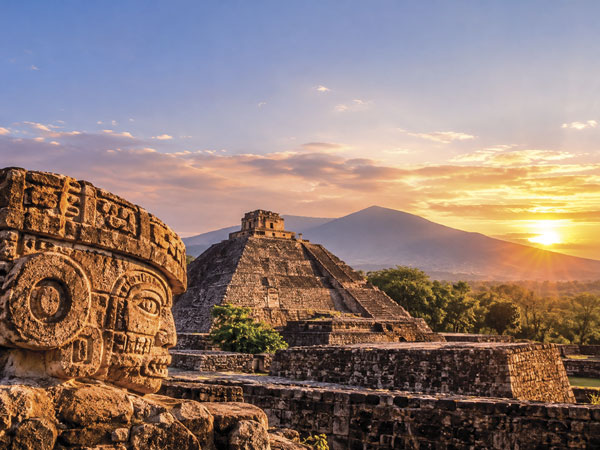
There is a French proverb I like: To understand all is to forgive all. Recently, I began to wonder if forgiving all could also encompass the Aztec religion which so shocked the old world when the conquistadores and missionaries sent back their reports. I must admit I’m not immune from that shock myself. Job one, of course, is to understand all. And while I’m not going to claim that I do, I have found that there is context that gives me lots to think about.
In the 14th and 15th centuries, central Mexico was plagued by repeated droughts, likely caused by repeated El Niños—Pacific Ocean warming which peaks near the time of the Christ Child’s birth. Repetition is also part of the Aztec calendar, which recognizes a 52-year cycle with One Rabbit as year one. The people believed One Rabbit years brought particularly severe drought and other climate catastrophes. Remarkably, tree-ring data support this belief, showing a statistically significant correlation between severe drought and One Rabbit years. (Actually, 2026 is a One Rabbit year and here we are facing a colossal El Niño!)
The 1454 One Rabbit saw a drought so severe that no rain fell, the chinampas were useless, the lake all but dried up, animals lay shriveled in the parched selvas, and a third of the people died. Everyone alive at the time of the conquest, 65 years later, was either a survivor (barely) of that disaster or a descendent raised with the tale, terrified of what could befall. Though One Rabbit in 1506 did not see a repeat of a drought, priests would have said it was because precautions had been taken—extreme precautions appropriate for extreme peril.
From the earliest times, Mesoamericans believed that humans had a reciprocal relationship with the forces of nature. Tlaloc, the force connected with the rains, emptied itself on the land, and in return had to be fed to be replenished. The sun expended its energy and died each night. Its rebirth in the morning depended on its receiving nourishment. They believed that human hearts, which literally contained divine energy, were the food the gods needed to keep the world going. Those whose hearts were removed were thought of as “giving their service.” Bloody offerings were also made in the palaces where rulers were piercing ear lobes or penises, and by ordinary people, as in Cosalá where all those little jars thrown into the lake held blood to feed Fish Woman.
Those sacrificed were mostly captives of the Flower Wars. Large armies of men who put on jaguar and eagle costumes and fell upon their neighbors became a central feature of Aztec culture. This became sufficiently unpopular with the neighboring Tlascalans and others, that they eventually joined with Cortéz in the conquest and made it possible.
In 1530, a decade after the fall of Tenochtitlan, the Franciscan friar, Bernardino de Sahagún, arrived in Mexico. Though he was certain the religion of the conquered people was devil worship and was deeply involved in converting them to Catholicism, he blessed us by having the soul of an ethnographer. From 1545 to 1590, he worked on Historia General de las Cosas de Nueva España—now held in Florence and known as The Florentine Codex. He learned Nahuatl and, using informers, he recorded everything he could discover about the calendar, the identity of the gods and how they were served, the organization of society, occupations, crops, natural history and more.
The codex is a staggering 2,500 pages of text with 2,000 illustrations by native artists from which we get a deep understanding of how the people saw themselves and their world. Sahagún’s work was not translated for 200 years and not much noticed for long after that. But since 2023, it has been available online in English. To read it is a significant undertaking and while parts are apt to make you queasy (though no more so than reading about the Inquisition), it is a priceless document.
Considering the religious ideas and practices that came with the Spaniards 500 years ago, Sahagún was likely most deeply concerned that the horrendous offerings were to false gods. After all, the conquistadores and the missionaries came from a European scene that practiced public burnings and beheadings, ghastly tortures and punishments, 30 years’ wars, 100 years’ wars, and crusades involving killing and more killing. But, as this was all carried out under the aegis of the true God, the one God, it was all as it should be. Christian monotheism considered itself to be simply correct and superior, though whether it led to less bloodshed or suffering than what was going on in Mesoamerica is highly debatable.
Throughout the landmass of Asia/Europe, the earliest religions we know of used human sacrifice and sent retainers, spouses and consorts to accompany the important dead in the next life. But, eventually, arising from some of the many cultures that had alternatives to offer, the notion that animal sacrifice could placate gods gradually caught on. Until the destruction of the temple, Jews ran a virtual abattoir next to the Holy of Holies. Muslims sacrificed goats at Eid to commemorate the narrowly averted ritual killing of Isaac. Finally, the Mass sanitized the notion of blood sacrifice.
The Aztecs did not have neighboring cultures saying that they had successfully fed Tlaloc hearts of dogs instead of people. Theirs was a culture burdened by two centuries of such existential climate dread, its people dared not reconsider their rites. Who was foolish enough to suggest offering something else to the gods in place of the divine substance humans contained deep in their bodies?
The good friars who came to convert Mesoamerica offered belief in Jesus as the way to salvation. What they were saving their converts from was a fate the indigenous people never could have dreamed of. Sahagún’s informants agreed that the way you died, not some moral standard or belief, determined the nature of your afterlife. Old age or a particular disease, suicide or drowning, in battle, by sacrifice, or in childbirth—these were what determined your path for the few years through the underworld before you merged with the ineffable. Not so, according to missionaries. They offered the possibility of the worst imaginable suffering for all eternity if one deviated from the prescribed path.
Poor México. First priests said the sun wouldn’t rise unless there was war and captives and sacrifice. Then new priests said you wouldn’t go to mictlán but to some place completely horrendous if you didn’t do as they said. After the temples were destroyed, the sacrifices prevented, and the captives released, the native population might blame the diseases and enslavement that followed on abandoning the old religion. However, they couldn’t deny that the sun rose and the rains fell and food could be grown without feeding the gods. As for the new religion, Mexican history shows the country remained more than a little dubious. Day of the Dead celebrations show that the people never fell into the abject terror of hell the old world suffered from.
Ten years after the conquest, just as a 52-year cycle was drawing to a close, a vision appeared to the newly converted Catholic Juan Diego on a hill where human hearts had once been offered to three female deities: earth, fertility, and childbirth. Collectively, they were known as Tonantzin, meaning Our Revered Mother. In a counterintuitive miracle if ever there was one, the two fierce religious traditions collided and…mixed, producing a cultural mestizaje that, like the mixing of Spaniard and indigenous peoples, is the pride of México. Juan Diego beheld a new sort of divine being. Demanding no sacrifice and threatening no punishment, the Virgin of Guadalupe appeared to offer her people nothing less than unconditional love.
Perhaps understanding the fears that drove these religious traditions brings us a little closer to forgiveness. It doesn’t make the suffering they inflicted any less terrible, but it does make the people who believed in them more human. And perhaps that is where forgiveness begins.

 Discover trusted local services and hidden gems with our easy-to-use online directory.


- Lifting the Curse of One Rabbit - November 27, 2026
- Profile: Cathey Merrill - October 29, 2026
- Profile: Diane Pearl - August 29, 2026