The Virginal State and the Age of the Feminine
I grew up questioning the status of women in the Church, which in the Dominican Republic, where I was born, is predominantly the Roman Catholic Church, as it is also in Mexico, where I now live. Even though supposedly the son of God was born of the Virgin Mary, placing her in an exalted position as the “Mother of God,” I still didn’t see an equal presence of women in leadership along with men.
The saint patroness of the Dominican Republic is the Virgin of Altagracia. She’s celebrated on January 21, which is a national holiday. Growing up, I remember all of us girls each bringing a calla lily to church as part of the celebration. It was a wonderful day full of enchantment for me. Here was this woman at the center of our collective devotion, if only for a day. But the inequality I witnessed in the Church caused me to abandon religion altogether.
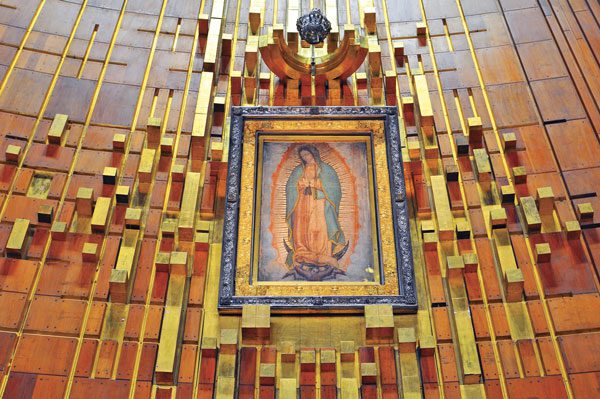
In Mexico, I found a richer culture and acknowledgment of feminine iconography in the religious streams of popular celebrations. The Virgin of Guadalupe in this land rose to the highest place any deity could achieve. Living in Mexico in my 20s, I became curious about this phenomenon and was unable to ignore the power of the feminine, even when I had nothing to do with the Church. Many local festivities were centered around feminine images.
I entered a world of people living close to the unconscious, maintaining a vital connection with rituals and ceremonies that incorporate many pre-Hispanic elements. Here I saw the new and the old woven together in a rich tapestry of great beauty and magic that I only encountered again on later trips to India and Bali. I found my spirit nourished, as this fertile land welcomed exploration of my inner world in a supportive, nurturing environment. In this Mexican landscape, I had my first glimpse of the Goddess as a real force still alive in many native cultures.
What is important to understand is that the Virgin of Guadalupe is not the Virgin Mary: she doesn’t have a child in her arms, she is brown, and the snake at her feet is not the symbol of evil as the early Catholics interpreted it. Rather, the snake is the most important symbol in both eastern and western ancient civilizations, including among the indigenous Mexican cultures.
In the streets of Ajijic, we can see many shrines to Guadalupe and snake murals everywhere. Even when the artists may not be fully aware of its deep meaning, the snake archetype in their psyches manifests itself.
To discuss the primary image that arose in Mexico, let me quote from Alicia Mayer, historian and research professor at the National Autonomous University of Mexico:
“The cult of the Virgin of Guadalupe in Mexico is much more than a religious expression. It is a fundamental pillar of national and cultural identity.”
With a history dating back more than four centuries, this devotion has become deeply rooted in the fabric of Mexican society. It spectacularly manifests itself every December 12th when millions of believers converge on Tepeyac Hill in Mexico City.
But how did it happen that the Virgin of Guadalupe transcended her religious context and became a symbol of Mexico’s identity?
During the insurrection for Mexico’s independence from the Spanish Crown, José Miguel Ramón Adaucto devoted himself to the Virgin, left his studies in 1811, and joined the independence movement, changing his name to Guadalupe Victoria.
He made the abolition of slavery effective so that all the inhabitants of the country could live free. Mexico was born with a non-slave identity.
Today, those values have been taken up by the Fourth Transformation. This transformation is characterized by placing a priority on caring for the poor and indigenous populations of the country.
The Morena Virgin (another name for the Virgin of Guadalupe) has been borrowed by the Morena Party (Movement of National Regeneration, Movimiento de Regeneración Nacional), which, in recent years, is not only giving hope back to the Mexican people but has recognized her indigenous peoples as the original peoples of the land who are the essence of Mexico and its wealth.
La Presidenta, Claudia Sheinbaum, is committed to continuing the Fourth Transformation: taking Mexico to a new plateau, focusing on building life instead of making war, ending corruption, creating new universities for young people, supporting women, and the elderly. Her outlook is stated thus: “This is the time of women. I don’t arrive here alone; we all arrive together. For the first time, we women can direct the destiny of our nation.”
The Virgin’s presence in our lives as a myth can help us remember that within us is the capacity to manifest the divine. Her birth and incarnation over and over in cultures everywhere are proof that she can’t be forgotten because she is the one where the opposites are united in a deep connection, in a deep embrace, in a profound interpenetration, giving birth to the divine nature within us, not to a child, but to a process of regeneration and rebirth.
Noris Binet is a visual artist, author, writer, poet, therapeutic counselor, sociologist, environmental activist, and spiritual teacher.

 Discover trusted local services and hidden gems with our easy-to-use online directory.

- La Virgen de Guadalupe: The Goddess of the People - November 30, 2025
- Recovering the Sacred Feminine: - July 29, 2025