
When traveling, chance encounters with strangers sometimes become instant personal connections if you have places, people, or experiences in common. My husband and I felt that familiarity halfway around the world, while cruising on a small ship adventure from Mumbai, India to Mombasa, Kenya. Crystal Cruises engaged world-renowned speakers to educate and entertain passengers, as we traversed the Indian Ocean. Lectures by Bill Toone, natural history and destination speaker, became a staple of our onboard sea day program. A member of the elite Royal Geographical Society, Bill also served for 35 years as Director of Applied Conservation at the San Diego Zoo.
In his dynamic, fact and emotion-packed presentations, Bill offered stories of his life-long personal commitment to conservation work. As leader of San Diego Zoo’s strategy of captive breeding, he and his team saved the magnificent California Condor from near extinction. Condors rebounded from a meager population of 23 birds, (6 in the wild, plus those in captivity) to a thriving population of over 400 of the New World Vultures. He is helping to preserve the natural habitat of the Bwindi mountain gorillas of Uganda, while assisting the local Batwa Pygmy people. He also led an intense project to promote improved health and nutrition among indigenous tribes of remote Madagascar. Bill’s approach to each project searches for solutions that will not only help to conserve landmasses, birds, and animals, but will improve conditions for the human inhabitants of these remote regions as well.
Our common thread with Bill Toone unfolded during his lecture on current conservation and humanitarian efforts in Michoacán, Mexico. Historically a billion, now between 100 and 150 million, Monarch butterflies migrate to overwinter in remote mountain-top sanctuaries on Mexico’s Transvolcanic Belt. For 20 years, my husband and I have lived as expatriates in Lake Chapala, Jalisco, Michoacán’s neighboring state. We have visited the 10,000 ft. summits of oyamel forests of pine, fir, and junipers, within the sanctuaries of Michoacán’s Monarch Butterfly Reserve. The sight of tree boughs laden with impenetrable peach-hued clusters of these hibernating beauties gave pause as we marveled at one of Mexico’s great legacies: the mysterious, natural wonder of Monarch migration to this same area for unknown millennia. Over a decade ago, we learned that butterfly migration numbers suffered due to environmental changes in the oyamel forests.
In 2003, Bill Toone founded ECOLIFE Conservation, a nonprofit organization that strives for “solutions for people and nature together.” When the Monarch situation was brought to his attention in 2017, Bill established an ECOLIFE Conservation chapter in Morelia, capital of Michoacán, Mexico, to begin conservation work in the Monarch Butterfly Biosphere Reserve – MBBR. As past Director, Bill remains an active board member of this ECOLIFE unit.
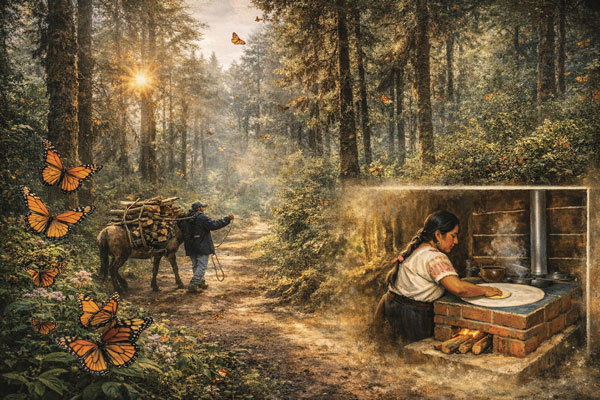
Universally, a direct correlation exists between increased human habitation, environmental changes, and decreased flora and fauna of a given region. Most of the Monarch reserves are located on ejido land, where Mazahua indigenous communities like Cresensio Morales thrive. These people, along with 28 million others in Mexico, still cook inside their homes with wood on open fires that have no outside ventilation. The women, along with their families, develop serious respiratory issues due to inhaling smoke, ash, soot, and fumes trapped within their kitchen areas. Cooking on open fires uses more than 24 kg of wood every day. This requires cutting down trees, trees from the very oyamel forests that the Monarch butterflies select for their winter hibernation. Tons of emissions released into the atmosphere damage the natural vitality of these forests.
Bill Toone realized that a solution to improve the health of the local indigenous people, the forest, and the nesting grounds for the migrating Monarchs required an alternative method of daily food preparation. Through ECOLIFE Conservation, he proposed in-home installation of efficient, Patsari cook stoves, which use far less wood and have smoke and soot vented outside through chimneys. These could be the answer to the pressing issues and support sustainable development.
Along with 40 local ECOLIFE employees, Bill’s nonprofit company inaugurated two conservation projects in 2017, which sprang to life in the MBBR; Tsasú to benefit the Mazahua people and Amanba Ocherí, which concentrated on the Purépecha groups. According to the Tsasú Project 2026 Work Plan and Strategic Projection, since inception, the organization has replaced in-house, open-fire cooking components with 16,000 Patsari cookstoves, positively impacting over 70,000 local inhabitants.
Addressing the importance of educating the locals about the conservation goals and the benefit to their overall well-being, ECOLIFE continues to organize environmental workshops in each community. Acceptance of changing their centuries old method of cooking and allowing workers into their homes to construct a Patsari stove with bricks, mortar and chimney came slowly for the indigenous groups. An increase in the number of installations has enhanced awareness of the project advantages.
These revolutionary cookstoves are saving 5.6 tons of firewood per stove annually, giving more of the sacred forests back to the Monarchs. CO2 emissions have also been drastically reduced. So, ‘What’s Cookin in Mexico’s Monarch Butterfly Reserves?’ Girls and mothers prepare rice, beans, tortillas, menudo, and tamales without having their lungs constantly filled with caustic smoke, and cooking utensils remain free of burned-on soot. The arduous task of collecting firewood every day has been minimized, conserving the forest resources for the rural community and the wintering ‘guests’ which draw thousands of tourists to the area.
The 2026 Tsasú Project goals anticipate installation of 1800 Patsari stoves, and an expansion of the program into more communities within the MBBR area. Materials, transportation, stove kits, and labor cost about $300 USD per stove. Anyone interested in supporting this incredible conservation tool for the people of the MBBR region and the Monarch migration butterflies, can donate at www.ecolifeconservation.org/donations.1
Bill Toone and his wife Sunni lead small tour groups to the MBBR every February when the Monarch hibernation is at its peak. Go with Bill, go independently, go with another tour group, but go to Michoacán, Mexico to witness this magnificent natural wonder and the conservation of ‘people and nature together.’ Note: Bill Toone will be speaking at Lake Chapala Society’s Open Circle on May, 17, 2026.
_______
1 General information and data offered, taken from Tsasú Project 2026 Work Plan and Strategic Projection derechos reservados/ECOLIFE Conservation

 Discover trusted local services and hidden gems with our easy-to-use online directory.


- What’s Cookin’ in Mexico’s Monarch Butterfly Reserves? - April 28, 2026
- The Third Death - January 30, 2026
- Greenland’s Icebergs, Inuits and Summertime Insects - December 29, 2025