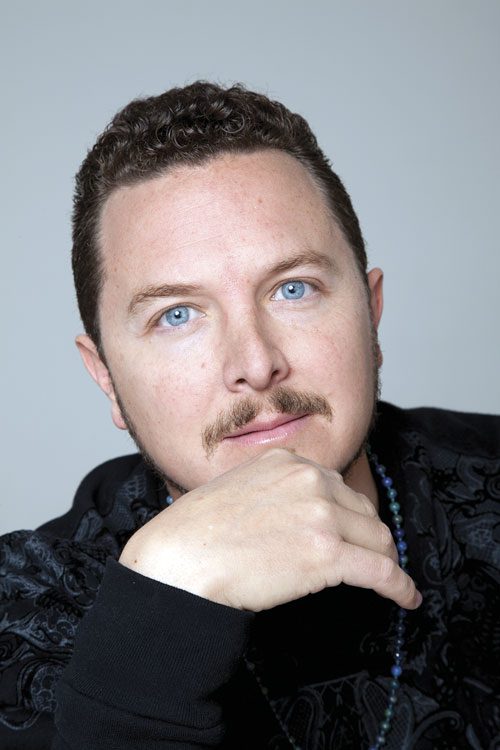
Oskar Santoscoy carries the quiet confidence of someone who’s done the hard part already. He is a professional poet who also curates three branches of his Galló Art Gallery, one in Riberas del Pilar, the other two in Puebla and San Miguel de Allende. In addition, he’s an award-winning actor who has studied literature and semiotics (the study of signs and symbols). This combination of education and practice honed his natural brilliance, as evidenced in his six published books of poetry: Agua del Alba (Water of the Dawn), Encuentro (Meeting), Corazón del Viento (Heart of the Wind), De la Poesía al Lienzo (From Poetry to Canvas), Olas de Oro (Golden Waves), and Son de Palabras.
Son de Palabras won the 2021 National Tintanueva Poetry Prize. This prestigious award is presented by the magazine TintaNueva to honor outstanding contemporary poetry and promote emerging literary voices. I hesitate to translate the title of this collection of sonnets because, like all of Santoscoy’s work, it is rich in meaning. The title is, at a minimum, a triple pun. There is the literal meaning, “They Are Words.” It could also translate to “Sound (or music) of Words,” which has a poetic resonance. And finally, it hints at “Sonnet of Words,” which alludes to the formal structure of the poems.
Consider this English translation of his poem El Grillo Canto from Olas de Oro which captures both the lyricism and depth of Santoscoy’s work.
The cricket sings, the night is a silence of full moon. Is it the star that listens to the echo of the goldfinch?
In this poem, written in Chapala, he captures a luminous paradox: In the music of small creatures and the silence of a moonlit night, the universe listens to itself. It’s a meditation on interconnectedness, perception, and the sacred echo between sound and silence, between earth and cosmos.
Santoscoy’s connection to nature and appreciation of the artistic diversity here drew him to the Lake Chapala area. As someone with a keen sense of observation, he feels he is in constant dialogue with the natural wonder of our little slice of paradise. He also feels the artistic energy here works as a catalyst to inspire better work and collaboration. His gallery features art by both nationally known and local artists with the intent of drawing attention to the cultural wealth of our community.
Santoscoy thinks of himself as a poet first. His poetry expresses itself in many forms – haiku, tanka, free-verse, sonnet – but all of it drips with mysticism and the celebration of nature. His mastery and manipulation of imagery, symbolism and syntax draw the reader into an unavoidable contemplation of deeper meanings. And it is accessible. Critics (perhaps myself included) like to show off their literary chops in the interpretation of this deeply layered poetry but even a casual reader can find peace, music, and a gentle awakening of perception. His poetry is designed to be open, not obscure. The language is clear and descriptive. It gives us an appreciation of the everyday, an invitation to stillness.
“Poetry is simply an echo of existence,” Santoscoy believes. “I try to live as close as possible to natural places in order to observe them and transcribe those experiences.” In his work, that echo becomes a bridge between silence and sound, between the seen and the felt. Santoscoy reminds us that poetry is not a luxury but a way of perceiving the world, an act of attention that turns existence itself into art. We’re fortunate to have his voice resonating here in our community, grounding global vision in local light.

 Discover trusted local services and hidden gems with our easy-to-use online directory.


- Editor’s Page – October 2026 - September 30, 2026
- Good Works Gazette – September 2026 - August 29, 2026
- Editor’s Page – September 2026 - August 28, 2026