
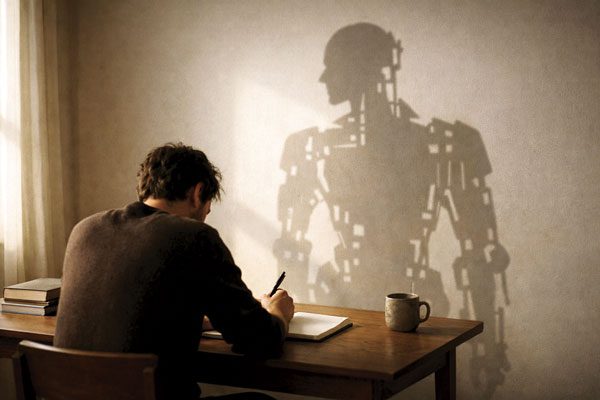
Artificial Intelligence offers tempting tools for writers of all kinds. For students and academics, it speeds up research, structures arguments, and polishes grammar. For creative writers, it generates story prompts, plots, and poetic language. These conveniences save time and effort—seemingly a win-win.
It’s no wonder that students, under pressure to produce assignments quickly, or new writers eager to publish, often embrace AI. Some even use it with the help of AI-detection tools to erase the evidence. The result? Higher grades or platform monetization. But at what cost?
The distinction between author and scribe becomes critical here. Those who depend heavily on AI are not authors in the truest sense—they are scribes, conduits for machine-generated language. They may rearrange and disguise AI work, but the core ideas, structure, and even voice often come from the tool, not the human. The author’s role is lost.
This isn’t a new dilemma. In the Middle Ages, scribes copied sacred texts like the Bible or classical works like The Aeneid. They preserved culture but rarely claimed originality. With the invention of the printing press, their role diminished—but didn’t disappear. Scribes evolved into scriveners, handling contracts, records, and correspondence. Over time, they were replaced by typists, secretaries, and eventually word processors. Each wave of innovation devalued a layer of human labor.
In the 21st century, it was coding that was promised as the golden skill. Schools, camps, and institutions rushed to prepare students. Yet, in less than a decade, AI now writes much of that code. Entry-level jobs in the field have disappeared. Only a handful of specialists remain to fine-tune AI output, until they, too, are replaced.
AI, then, is not a neutral tool. It’s part of a system that extracts human skill, packs it into algorithms, and eventually makes the human obsolete. Writers now face a choice: become passive facilitators of machine-made content—or insist on creating authentic, original work. It’s a difficult path. Originality takes time, effort, and often yields no immediate reward. But it’s a path rooted in selfhood.
As Herman Melville’s Bartleby the Scrivener famously “preferred not to” continue his mechanical work, writers today must ask: Who am I in this process? Do I choose authenticity over convenience?
To write authentically is not just to produce something new, it is to discover who you are. William Stafford once said, “A writer is not someone who has something to say. He is someone who in the process of writing discovers things to say that would not have occurred otherwise.” Without that process, writing becomes imitation, not expression. The cost is not just literary, it’s existential. As Walt Whitman urged, “Dismiss what insults your soul.” To choose authorship over automation is to choose the soul over the shadow, the human over the machine.

 Discover trusted local services and hidden gems with our easy-to-use online directory.


- Author or Scribe: Authenticity and AI, a Minor Matter? - March 31, 2026
- Teaching From The Heart - March 30, 2025
- Volunteering in Nepal: Loitering in Lucknow - January 30, 2025

This article articulates so very well the challenges we face to remain human and not become scrivener zombies. That idea expands in dimensions.
Kudos to the Author! I admire the structure of your hard-hitting essay.
Thanks for your comment, Joy. Yes, it has also undermined teaching in many significant ways. One of the remedies is a return to books as evidenced by the new policies in Sweden; the use of handwritten exams in many cases at private schools and universities in the US, and finally the ban on cellphones and screen time in class. The biggest problem in the US seems to be administrators who were sold a bill of goods by software vendors on implementing AI in the classroom and have invested significant funds for its usage, often without consulting teachers. For many schools it is not only here to stay but the “30% AI written” is an acceptable guideline for student essays. A slippery slope.