
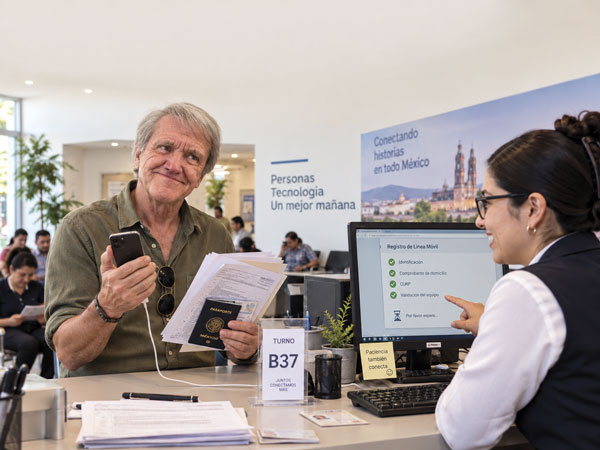
One of the problems with writing a monthly humor column is coming up with something funny to write about. So far, I’ve been pretty lucky at experiencing some silly incident involving a government bureaucracy that fills the bill. This June, the Mexican government came through once again.
On June 27, 2026, I read in the newspaper that I had only three days left to register my Mexican cell phone or face immediate service suspension. Apparently, in January of this year the government passed legislation requiring that every cell phone number must be verifiably linked to the owner’s identity. This enhanced security feature would help reduce fraud by people using anonymous “burner phones.” It was also supposed to prevent identity theft. Unfortunately, three days before the deadline, fewer than half the cell phone lines had been registered.
I’m not sure the Mexican government has the best track record when it comes to protecting my identity. Six years ago, when they issued my federal taxpayer’s registration number (RFC), they misspelled my last name. And earlier this year, when renewing my car’s license plates, they didn’t just misspell my last name. They eliminated it completely from all the associated paperwork. Even the “Vehicle Circulation Card” that I’m supposed to keep in my glove compartment as proof of ownership, shows only my first and middle names. And this was after my providing them with half-a-dozen government documents showing my correctly spelled name. I now live in dread of being pulled over for a traffic violation. My driver’s license will have a different name than my circulation card. I’ll probably get arrested for stealing my own car.
If any real identity thief wants to steal mine, he’ll have at least three different names from which to choose. And that’s before registering my cell phone. Who knows how much the Telcel clerk will butcher my Polish last name?
The newspaper article said there were two ways I could register. I could do it myself online. Or I could go to my carrier’s customer service center. I wasn’t about to try doing it myself. First, my Spanish isn’t very good. And second, I can’t even reprogram the digital clock on my car’s dashboard. I figured I’d trust the professionals at Telcel. After all, they have been registering phones for the past six months. Surely, they’ve got it down pat by now. The process couldn’t be too complicated. I only needed to provide my US passport, and my CURP number (Mexico’s universal personal identification code.) There wasn’t even a fee to pay.
So, on June 27th, off I went to the Telcel office. I signed in and took a number. Twenty minutes later, when my number was called, I was sent to customer service station number 13. That should have been a red flag. But the clerk was very pleasant and started entering information from my passport. After a half hour of hunting and pecking, he apologized and explained that the registration was a two-step process, and he couldn’t complete the second step. Why not? Because Telcel’s computer system was “down.”
What the hell? This is one of the biggest telecommunication conglomerates in the world. You’re telling me their computer technicians can’t keep the system functioning three days before an important deadline? He suggested I come back tomorrow when he “hoped” the system would be operational.
When I returned on June 28th, my clerk was busy with another customer. When he saw me waiting in line, he signaled me that their system was “up.” But when my turn was called, I found out that my system was “down.” I had forgotten to plug my phone into its charger the night before. Thank heavens one of the biggest telecommunication conglomerates in the world happened to have a spare charger and cord compatible with my antique iPhone 6.
As my phone was charging, the clerk went through the whole process of re-entering information from my Passport. Again, this seemed to be a rather lengthy process considering my passport has only nine words and three dates he could be entering.
He then used his company cell phone to photograph me, first looking straight on, then turning to my left profile, and then looking straight up. He was unsatisfied with the end result and had me pose again. This time he had me look straight on, then turn to my right profile, and finally look straight down. I guess Telcel’s facial recognition system requires a view up my nostrils as well as one looking down on my bald spot. Regardless, he was once again dissatisfied. Eventually, he decided the lighting would be better if we walked 50 feet to the front window of the store and went through the whole procedure again. Thankfully, the third time was a charm.
Once my cell phone was sufficiently charged, he sent me a brief text message saying “This Telcel line registration has been successful.” That was the only confirmation I would receive. No paper document with my name on it. They didn’t even include my name on the text message. I guess I’ll never know if, or how badly, Telcel misspelled my name. All I know is that it took two visits, three tries, and a full hour for the Telcel “professional” to complete the process. Perhaps they should consider hiring a few paroled cybercriminals to do this work.
By the way, a few days after I registered, a newspaper article said that the Telecommunications Regulatory Commission had made major changes to the program. They extended the deadline by staggered two-week intervals depending on the last digit of your phone number. Furthermore, photographs of the phone owner were no longer required. But more importantly, the thousands of people like me who have a Mexican cell phone contract that we pay monthly, no longer have to register their phones at all. My two-day encounter with bureaucracy was all for naught. It turns out those lines were already verifiably linked to the owner’s identity when we signed the contract with our phone company. Wouldn’t you think they’d have known this back when they passed the original law?
So now, only people with non-contract, pay-as-you-go phone lines need to register. Oh well, the good news is this one simple exemption will greatly reduce the workload of all the cell phone company staff. The bad news is the companies will no longer have an incentive to provide an honest employment opportunity for reformed cybercriminals.

 Discover trusted local services and hidden gems with our easy-to-use online directory.


- Cell Phone Security - October 29, 2026
- Paid Parking - July 4, 2026
- The Toothache Tree - May 30, 2026