The Himalayan country of Nepal has more deities than dentists. So, it should come as no surprise that there is a spiritual approach to dealing with dental problems. The solution is to appeal to a goddess called Vaisha Dev. Like most deities, she has her own shrine. It is located in Kathmandu, on a back street somewhere between the trekker’s district, called Thamel, and the 1960’s Hippie hangout called Freak Street.
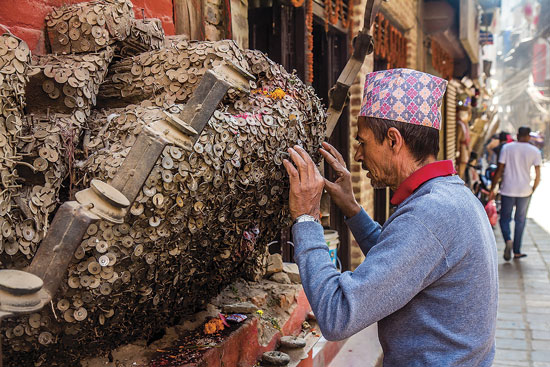
It isn’t a UNESCO world heritage site or an architectural wonder. There isn’t even a bronze statue of a woman with a toothy smile. Instead, it is simply the large, gnarled stump of an ancient tree. It is about the size of an upright piano. Legend has it that if you are suffering from a toothache, Vaisha Dev will relieve the pain if you nail a one-rupee coin to the Toothache Tree.
I can’t vouch for the effectiveness of this procedure, but it must work sometimes. Whether it’s just the placebo effect, or genuine faith healing, there is no shortage of people willing to try. Of course, to put this in its proper perspective, a rupee is worth less than a penny. So, what do they have to lose?
To give you some idea of how this custom might have originated, I should describe the state of dentistry back in 1991, during my first visit to Nepal. I was participating in a wildlife research project in the lowland jungle near the border with India. Many of the local villages did not yet have electricity. People were living in mud-walled huts with dirt floors and thatched roofs. There was no indoor plumbing. In fact, there was no outdoor plumbing. When they felt the need, they just sauntered off into the nearby jungle and did their business.
Clearly, these people did not have money for elaborate dental procedures. If you had a toothache, the local native healer would cauterize the nerve by pushing a piece of red-hot wire into the cavity. If all else failed, he would just pull the tooth with a pair of pliers. No Novocain, no ether, no laughing gas – just a few swigs of the local moonshine.
Even if someone had money, the only dental office was several miles away. It was only staffed once per month by a traveling dentist. When I peeked through the window, I could see no evidence of 20th century technology. A kerosene lamp hung over the dental chair, and the antique dental drill was powered by bicycle pedals. You can understand why people might prefer to make a last-ditch appeal to the Toothache Goddess.
It is unclear how long ago this custom started, but it is still going strong. I suppose someday an archaeologist will stumble upon this treasure trove of ancient coins and carefully pry them off to read the dates. But, as for now, the tree stump is completely encrusted with coins. There is no more bare wood visible. New supplicants have to drive their nail not only through their own coin, but several layers of coins underneath. That can be challenging. There’s no telling how many people have smashed their thumbs trying to hold their nail and coin in place while whacking it with a hammer.
The amazing thing is that, after all these years, the Toothache Goddess hasn’t raised her fee. Everybody else has adjusted for inflation. For example, when I was a kid, the Tooth Fairy’s exchange rate for a baby tooth was 10 cents. Now, my grandchildren tell me it’s five bucks a pop. I can’t imagine why. As far as I know, the procedure for extracting a baby tooth hasn’t gotten more expensive. No Novocain, no ether, no laughing gas – certainly no moonshine. Just a piece of thread tied to a doorknob.
Thankfully, the Toothache Goddess is not greedy. If she were after the money, she’d have installed a credit card reader long ago. It seems that all she really wants is a coin, regardless of its value or where it came from – as long as it’s metal. Heaven forbid that she ever gets sucked into accepting Bitcoin.
If the nearly worthless rupee coins eventually become scarce, there may be an opportunity for the U.S. to unload some of its recently discontinued pennies. I wouldn’t be surprised to see some enterprising Nepali street vendor setting up shop next to the Toothache Tree and selling nails and pennies. For an additional fee, he could pre-drill the nail holes. All he’d need is one of those obsolete pedal-driven dental drills.

 Discover trusted local services and hidden gems with our easy-to-use online directory.


- Paid Parking - July 4, 2026
- The Toothache Tree - May 30, 2026
- GPS – 101 - April 30, 2026