
Learning to See in Mexico
The 19th century naturalist, Louis Agassiz, once handed his students a preserved fish and told them simply, “look at it.” Hours passed. Then days. Frustration grew as the students insisted there was nothing new to notice about the dumb, dead fish. Slowly, almost reluctantly, new details began to emerge, structures they’d missed, patterns they hadn’t noticed, relationships between parts they had never considered. The fish hadn’t changed, just the way they saw it.
My mom was a would-be naturalist who noticed every new bloom, every rock or cloud formation, every bird migration. I notice some of these things but also the delicious variety of house colors in Mexico and the way my neighbors laugh when they’ve had a beer or two. That’s the thing; we only see what we’re prepared to notice.
Some of this preparation comes from our culture, some from our personal experiences and some from that mysterious part of ourselves that seems innate. The first two of these lenses are shattered when we step into a new place and culture. To be sure, nature has universal laws and, for me, a comforting familiarity. But every place holds more than we can ever grasp. Every object, every street, every face contains layers we may never entirely uncover or understand, especially in a foreign land.
Rather than being depressing, this truth feeds my heart as it promises a lifetime of discovery. As with the fish, this “seeing,” or discovery, can happen anywhere. It doesn’t require exotic locales or fantastical objects, just curiosity and a willingness to be present and open. There are, for example, any number of architectural gems in Chapala. Guillermo de Alba’s “Mi Pullman” house (designed to resemble a Pullman rail car), his equally impressive and elegant train station, and Luis Barragán’s modernist, ship-like Villa Robles all come to mind.
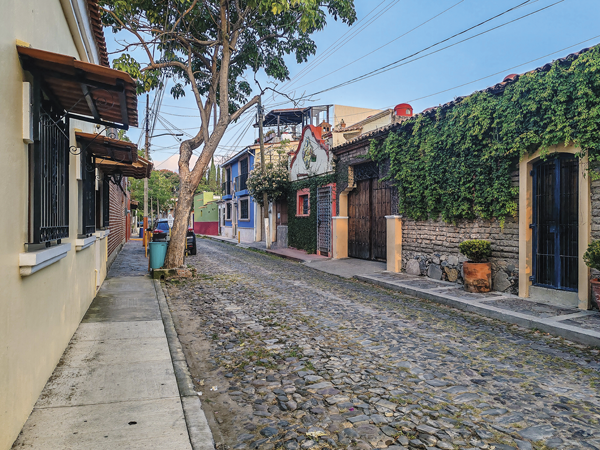
However, I began to notice the “ordinary” houses in my neighborhood have extraordinary doors. At first, they were just doors, nothing fancy about them. But the more I started to notice them, the more they began to distinguish themselves. Some have wrought iron stars, others azure panels of Florentine glass. There are seemingly endless combinations of stylized hearts, geometric patterns and floral motifs. Each one is unique.
The doors were never ordinary. I simply hadn’t learned to see them yet. This isn’t the first time I’ve had such revelations, but the context is new. I’m reminded (again) the world is far richer than it first appears, and that what we call mundane may only be what we’ve stopped noticing.
Living in a new place can sometimes feel disorienting, even overwhelming, but the more we notice, the more we really see, the more connected we become. In a life that can feel untethered – new language, new customs, new patterns – the simple act of observation becomes grounding. Pausing to really see quiets the urge to understand everything all at once and replaces it with curiosity and appreciation. In time, what once felt foreign begins to feel like home.

 Discover trusted local services and hidden gems with our easy-to-use online directory.


- Editor’s Page – October 2026 - September 30, 2026
- Good Works Gazette – September 2026 - August 29, 2026
- Editor’s Page – September 2026 - August 28, 2026