Chapala’s Open-Air Museum
You don’t need hiking boots, a bicycle, or even particularly sturdy legs to enjoy one of Lakeside’s most interesting outdoor excursions. Chapala’s malecón offers a leisurely journey through centuries of local history, told through sculptures, monuments, murals, and even graffiti. Much of the route can be enjoyed by people using wheelchairs, walkers, or canes, with plenty of benches for those who prefer to take their time.
Begin at the Church of San Francisco de Asís, where the mismatched bell towers tell us a bit of the church’s history. The smaller south tower dates to 1878, while its larger companion was remodeled around 1970. Some say the project ran out of money before the second tower could be enlarged; others claim the older structure couldn’t support the additional weight. Whether it was for one of those reasons or because someone simply wanted to preserve the historic architecture, the different heights have now become iconic.
From the church, walk toward the lake and turn right at the Beer Garden restaurant. Your first stop is a bronze statue honoring Mike Laure (1937–2000), which was unveiled in 2008. Known as El Rey del Trópico (King of the Tropics), Laure began as a rock-and-roll musician before blending those rhythms with Colombian cumbia to create a distinctive sound. His hits included Tiburón, tiburón and Amor en Chapala, a tribute to the town where his career took off.
Continue along the waterfront to four sandstone sculptures created during a 2015 arts festival intended to raise awareness of Lake Chapala’s environmental problems. For nearly two weeks, four artists worked outdoors, transforming large blocks of stone into public art while curious spectators watched.
First is La Última Gota (The Last Drop), by Estela Hidalgo, featuring an elongated drop of water suspended above rough stone. Next comes Tributo al Lago (Tribute to the Lake), by Dolores Ortiz, whose undulating layers evoke the movement of water. Emerger (To Emerge), by Estanislao Contreras, depicts a cubist fish rising from the water, its angular forms revealing the artist’s distinctive approach to sculpture. The fourth work, Movimiento (Movement), by David Agredano, completes the collection. Together, these sculptures invite us to consider the lake’s beauty and fragility.
Just a few more steps brings you to La Vela (The Sail) at the west end of the malecón, where you’ll find a tourist information booth (although it’s not always open) and a public restroom. From there, retrace your steps toward the church.
On your return, pause beneath El Zalate de Feliza, an ancient fig-family tree named for Doña Feliza, who once sold homemade ice cream in its shade. Local history places the entrance to Chapala’s old cemetery beside this very tree. The cemetery remained in use until 1865, making the tree a living link to a very different Chapala.
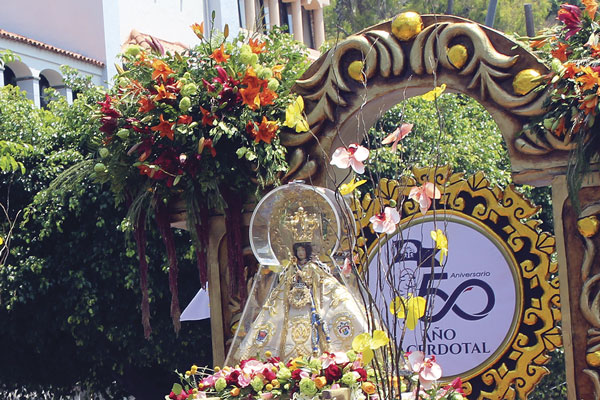
Facing the tree, turn right. Almost immediately, you’ll encounter the five-meter statue of the Virgin of Zapopan, created in bronze-colored fiberglass by sculptor Mario Andrade and installed in 2015. The monument honors La Reina del Lago (Queen of the Lake), whose first visit to Chapala in 1955 followed prayers for the recovery of the drought-stricken lake. Her annual visits remain an important tradition, with devotees praying for abundant rainfall and the lake’s well-being.
Almost directly across from her stands a curious newcomer: a vertical-axis wind turbine, installed in 2026 as an experiment in renewable energy.
Next comes the Fuente de los Pescadores (Fishermen’s Fountain), inaugurated in 2000. Four muscular fishermen carved from cantera stone work together to haul a large net, demonstrating a traditional team-fishing technique no longer practiced on Lake Chapala.
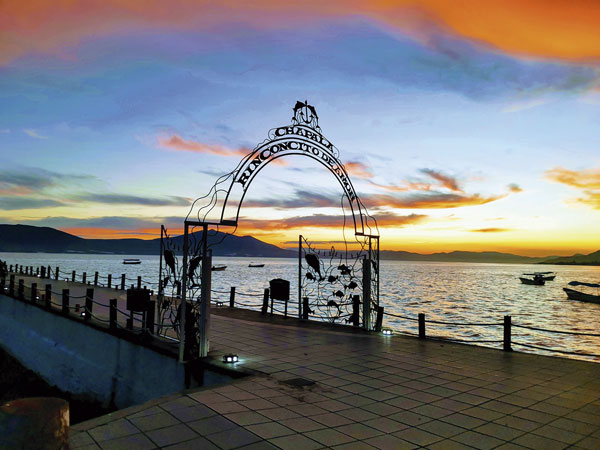
Farther along, Rinconcito de Amor (Little Corner of Love) is a pier extending into the lake, with a small lighthouse at its end. Look up beneath the lighthouse roof to discover panels painted by local artist Miguel Mora in 2007. They depict Chapala’s Indigenous beginnings, Spanish evangelization, the resistance on Mezcala Island during the War of Independence, and the lake’s devastating drought of 2001.
Returning from the pier to the main malecón, turn right. Before reaching the statue of Jesús Pescador, you’ll pass Chapala’s skatepark, an unlikely outdoor art gallery. Its concrete ramps and walls are covered in exuberant, colorful graffiti that changes so frequently no two visits are quite alike. Bring your camera; this may be the most unpredictable exhibition on the entire tour.
Finally, look toward the lake, where the five-meter bronze statue of Jesús Pescador (Jesus the Fisherman) stands on a small artificial peninsula. Installed in 2009, the figure connects Chapala’s fishing heritage with the biblical story of Jesus calling his disciples to become “fishers of men.”
The beauty of this excursion is that there’s no need to complete it all at once. Stop for a coffee, watch the pelicans, or simply sit and admire the lake. Few places offer such an engaging blend of natural beauty and human creativity.
Interested in contributing to Outdoor Living? We welcome up to 700-word guest columns from local enthusiasts who enjoy sharing their favorite outdoor activities and experiences. Please send submissions to editorelojodellago@gmail.com with the subject line: “Outdoor Living.”

 Discover trusted local services and hidden gems with our easy-to-use online directory.


- Outdoor Living – December 2026 - November 28, 2026
- Why Easter Moves - February 28, 2026