My best job was my first. During the summer when I completed my 14th year, 1956, with my dearest friend, Laurel, (dearest then and still today) I refinished the carousel horses at Audubon Park in New Orleans. If Laurel were telling this, she would say “flying horses;” as a child, I said “merry-go-round.” The beloved has many names.
It was, of course, she who arranged this fabulous adventure, with a nudge from her imaginative mother. She sent a letter to the front office of the park and proposed that we be hired to paint the horses, which she had noticed were quite shabby. She didn’t mention our age. At an interview, with vague assurances that she had done art projects of the sort (“Well, I had painted my room!”) and by making the guys in the front office laugh with some banter about hoof and mouth disease, she landed the job. She reached as far as she dared and asked for five dollars a horse.
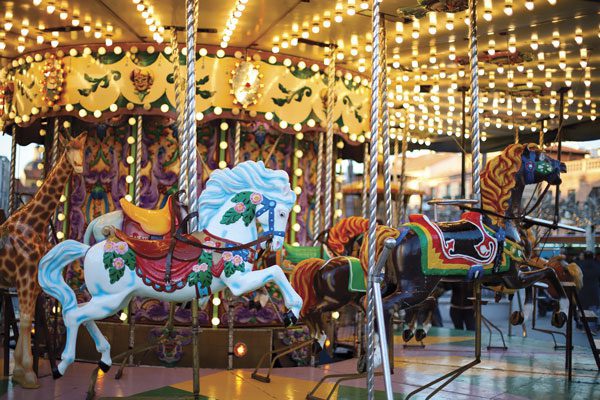
The horses paraded in a colossal barn amid the colossal oaks, with doors that opened almost all the way around to catch the least breeze, though, once the mechanism started up, and you were in the saddle, the carousel’s charm was not least in its cooling effect. New Orleans reliably provided the sweat to be evaporated. A painted and figured Wurlitzer band organ played a limited number of tunes over and over without becoming the least annoying. (“So, kiss me my sweet, it’s the loveliest night of the year!”) Mirrors reflected the whirling menagerie, cameoed paintings hid the mechanism in the center, and a tall ring dispenser, which only the big boys could reach, was positioned to one side. There was a smell with which I had been familiar for as long as I could remember — the droppings of the cooing pigeons coming and going through the cupola, dusty machine oil on the crankshaft which raised and lowered the horses, roasted peanuts … . My grandmother, seated in the chariot, held me at six months for a photograph. In another album in another house, a teenage uncle steadied toddler Laurel.
Our carousel was a Dentzel. In 1860, cabinetmaker Gustav Dentzel arrived in Pennsylvania from Germany and in 1867 became “G.A. Dentzel, Steam and Horsepower Caroussell Builder,” America’s first and one of the finest for beauty and detail. This carousel had come to Audubon Park in 1903. There were 48 animals — horses accompanied by a lion, a tiger, a giraffe, a bear, and two rabbits. Also, that chariot for the unadventurous, the baby-tending, or us at lunch break. The horse figures of the outer ring — always the showpieces with arched necks, thick and exuberant manes and tails, flaring nostrils, and mouths pulling at bits — were so beautifully positioned that they seemed to be on the verge of rearing with excitement before lunging forward in their endless circle. Each had a different and elaborate harness, saddle, and tableau on their sides. One featured a jockey’s head and riding crop, another the faces of the four winds. There was a crusader’s caparison with jewels and tassels, cords and fringed drapery, the globe of the earth, a ship in full sail, Bacchus with goblet and grapes, a pirate’s chest cascading jewelry and gold coin, an eagle, minuteman, and American flag.
Clearly a throw-away project for the park, no sanding or stripping preceded the animals being set up, one at a time, on a pole in a little room to one side of the barn. Paint, brushes, and sprayer were provided to us. We calculated that we had two days to complete each animal in order to finish before school began again for 9th grade and we kept to the schedule. After each second day a completed animal would have dried overnight, been returned to service, and we would find our next patient waiting for us when we arrived, after hopping off the Magazine Street bus where it stopped in the park near the ten-sided barn.
First, we covered the life-like glass eyes with Vaseline (my mother’s suggestion) and then began spraying on the body color. The sprayer inevitably clogged and tedious time was required to reopen its little orifice. That damn sprayer was the only reason to possibly reconsider the Best-Job award. The compressor pulsed and the room filled with enamel mist that settled on our swathed heads and masked faces. For good or ill, no workplace safety regulations intervened. We changed the color in the sprayer and shaded the muscles, tendons, and bulging blood vessels, added a blaze, darkened lower legs or the lion’s mane, spotted the giraffe, painted the pinto, dappled the appaloosa, and striped the tiger. The choice of color combinations for the harnesses, caparisons, saddles, and scenic embellishments was serious business for us. With small brushes we painted the tassels, the crenellated martingales, the eagle supporting the back of the saddle, the rosy cheeks and lips on the human figures, the stars and stripes, and with very small brushes, not really of adequate quality, attempted to make finishing bits of striping and scroll work on our colorful tack. Hooves were painted black, horseshoes and bits silver, teeth white, gums, flaring nostrils, and tongues dark pink. Paint-encrusted Vaseline was wiped from the eyes.
When every exquisite detail of the carver was lovingly highlighted, then, in some hidden place, we painted a name for each animal. The names must be testament to our erudition and cleverness: Lady Godiva, Lighthorse Harry, Taj Mahal, Bucephalus, Osiris. The teen-age boys who ran the rides and concessions — child-labor like ourselves — and who clearly found us irresistible, hung out at the door to the room offering snow cones and icy drinks as bribes for our attention and tried to participate in the game of naming the animals. The boys wanted “Irving” for the lion. We wanted “King Farouk.” For once, a compromise: Irving Farouk, King.
A stream of park officials came to look at our work, not entirely hiding their surprise that we were still there day after day, and when we went to collect our money at the end, we were rewarded with not $5 but $10 for each and every animal. That made $240 for each of us. They thought we did a good job! My mother recommended that I put my money in the freezer for safekeeping. I can’t remember what I spent it on, but I can clearly remember the feeling of those cold bills which I extracted with fiscal responsibility, not spending it all in one place.
In 1968, Audubon Park sold the carousel and demolished the barn. I learned that it had been set up in Roswell, New Mexico, in the southern part of the very state where I was living. I wanted to go but procrastinated until it was too late. It was sold again, and no sooner had that happened but the buyer died and his bankrupt wife sold the animals off individually, scattered to who-knows-where.
The 1968 buyer of our carousel was Roswell grande dame, Marianne Stevens. Her oil-rich husband left her with plenty of funds to play in the carousel game and, with the whole rich adventure always somewhere on my mind, I got in touch with her in the 90s and asked for a visit. She lived in a very, very long ranch house on the dreary treeless plain of southern New Mexico, many hours from my home in the north. An egg custard-colored Duesenberg, also of extreme length, sat in the circular drive. No expensive, and somewhat tasteless, effort had been spared in her décor and cosmetic work. She told me about the many carousels she had owned and gave me a tour of her collection — in entry, dining and living room, den, bedrooms and kitchen — horses, the finest and most ornate, a tiger, a rare ostrich, and an antique child-sized French pig, were mounted on poles, as becomes a carousel creature. And oh, the finish on the horses! Air-brushed iridescences, shiny over-the-top works of art. Skill to put Laurel’s and my teenage work to shame, but not the heart and soul of it and, along with our amateur effort, suitability of purpose. No child could ever climb over Marianne’s figures, kick at those flanks and imagine their steed’s brave response.
Laurel and I treasure the intimacy of our time with the carousel and each other and never matched it with a better friendship. All day, every day, each moment in each other’s presence was perfect. We were never annoyed, never disagreed, and never failed for interesting conversation. The wonder that there was another person so like ourselves was mutual. Without the other, we might have felt like sole members of different species, as teenagers often do, especially the ones with the intelligence to imagine it. She was my touchstone and authority, but though I knew myself to be less of an original, it wasn’t by too much. We developed together the way to tell our story to ourselves: how many parts analysis, how much self-deprecating humor, what size pinch of acknowledged inexperience and callow youth, what measure of confidence and what of insecurity. We cut our shared template for seeing the world. And when it was done, on we went, buoyed by our first job, first wages, first responsibility, bursting with autonomy, into lives that perhaps never have felt so right again.

 Discover trusted local services and hidden gems with our easy-to-use online directory.


- PROFILE: Larry Kolczak - March 28, 2026
- PROFILE – Michael Reason - January 31, 2026
- Soul Man - January 31, 2026