
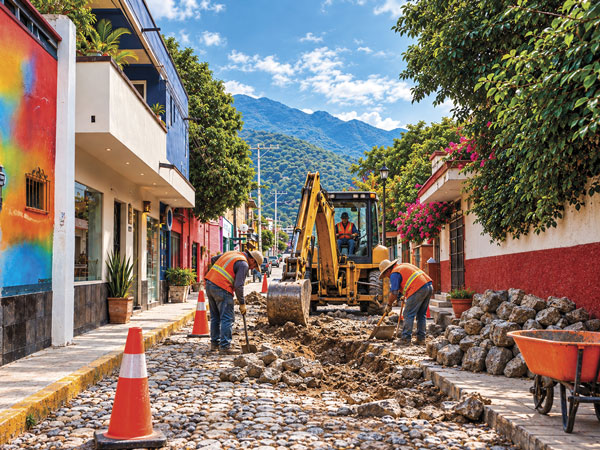
If your joints are aching a bit more than usual this season, or if your daily walk to the plaza has started to feel like an obstacle course, you are not alone. Living in Ajijic has always required a unique relationship with the ground beneath our feet. Our iconic empedrado (cobblestone) streets are a defining feature of our Pueblo Mágico. They give the village its historic soul, slow down traffic, and force us to look up and look down, and take our time.
Lately, however, navigating the heart of the village has felt less like a charming stroll and more like an archaeological dig. Between the massive underground cabling project tearing up central veins like Calle Morelos and 16 de Septiembre, and the heavy machinery rearranging our historic stones, getting around town has become a daily puzzle. For our older community members, these torn-up roads aren’t just a traffic headache, they are a very real challenge to mobility, independence, and peace of mind.
To understand the current mess, it helps to understand how these streets were built. Unlike the perfectly square, uniform granite setts found in European cities, Ajijic’s streets are made of piedra de bola (river and lake stones) and mountain stones.
For nearly 500 years, these stones were laid directly into sand and soil. This design is brilliant for one specific reason: drainage. When our torrential summer rains cascade down from the mountains, a standard asphalt or concrete road would act like a slide, turning our streets into violent, destructive rivers. The cobblestones act like a giant sieve, slowing the water down through friction and letting it sink naturally into the earth.
However, dirt-set cobblestones shift constantly under the weight of modern SUVs and delivery trucks. What we are seeing now in many areas is a transition to empedrado ahogado, “drowned” cobblestones, where the stones are set into a sturdy concrete mortar base. This hybrid method keeps the historic aesthetic and prevents deep potholes, while channels are built into the sides to handle the mountain runoff.
The current upheaval is part of a massive effort to modernize Ajijic’s infrastructure. Workers are digging deep trenches to bury kilometers of unsightly utility cables. It is loud, dusty, and frustrating. But the silver lining is significant. When the dust finally settles, the chaotic “spaghetti” of black wires, leaning wooden poles, and transformers will be stripped from our skyline. We will finally have unobstructed views of our famous murals, the mountains, and the lake. Resetting the stones into concrete bases will ultimately create a flatter, more stable walking surface for those using canes, walkers, or sturdy orthopedic shoes.
While residents find the dust annoying, our local shopkeepers are facing a much steeper uphill climb behind the barriers. When a street closes to vehicles, foot traffic drops drastically. Restaurants, boutiques, and tienditas tucked behind orange netting often look closed even when they are fully open. Our village economy relies on us keeping these places alive. If your favorite café or artisan shop is currently stranded, consider making the extra effort to visit them. Use side alleys, navigate temporary wooden footbridges, or call ahead to see if they offer delivery or curbside pickup at the nearest open intersection.
For many older residents, a golf cart is the ultimate ticket to independence, but the current landscape turns these lightweight vehicles into a bumpy liability. Deep trenches across intersections can swallow smaller tires, so slow down to a crawl when crossing gravel lips and give heavy equipment and dirt piles plenty of clearance. Never assume a dump truck driver can see your lower-profile cart. Give way to heavy machinery, and make sure groceries, pets, and passengers are secure before hitting the extra-bumpy tracks.
If you are navigating on foot, pivot your route to avoid the central grid when possible. The Calle Ocampo-Constitución corridor south of the highway can help you move east, while the westbound bypass near Galeana relieves central bottlenecks. Sturdy sneakers with good rubber tread are advisable on loose gravel, and for morning exercise, the flat paths of the malecón offer an escape from active construction. If a trench blocks your path, don’t hesitate to ask for a hand. Construction crews and neighbors are famously polite and ready to help.
Ajijic has survived centuries of changes, floods, and shifting tides. The very stones we walk on have been smoothed by generations of feet. This current phase of construction is undoubtedly a test of our collective patience, but it is also an investment in making our village a cleaner, more beautiful, and ultimately safer place to age in place.
So, take a deep breath, watch your step, and remember that the rhythmic clip-clop of Ajijic will return, just over a smoother path.

 Discover trusted local services and hidden gems with our easy-to-use online directory.


- The Rocky Road to Progress - October 31, 2026
- Among Animals - April 28, 2026
- Out of Fashion - March 28, 2026