Eighteen Holes, Nine Fairways, One Lake
Around of golf at Country Club de Chapala (CCC) rarely begins quietly. The parrots make themselves heard, donkeys call somewhere beyond the course, and announcements from San Nicolás de Ibarra and San Juan carry across the fairways. Then a group tees off, and the day begins.
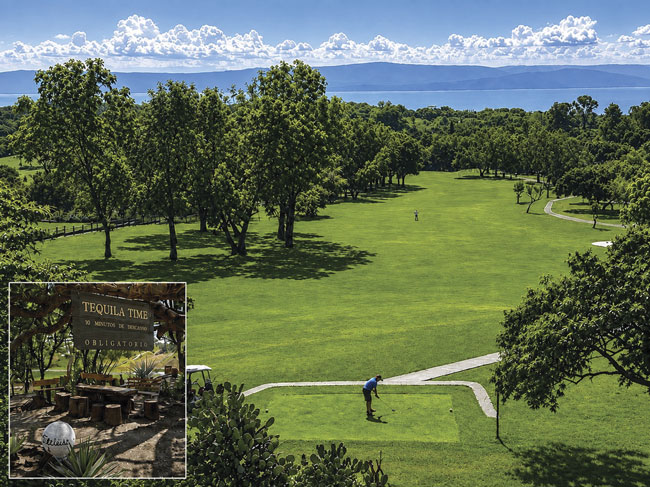
Set into the hills above Lake Chapala, the nine-hole course is played as 18. Trees, slopes, and elevation changes mean that a good score requires more than simply hitting the ball a long way.
The course has places where you can be aggressive and others where experience quickly teaches you to reconsider. The third is the club’s signature hole, where the elevated tee looks down over the fairway, with Lake Chapala and the mountains in the distance. Even members who have played the hole hundreds of times still tend to notice the view. Then comes the golf shot. Sometimes it is exactly the one you imagined. Sometimes it is not.
Fortunately, there is Tequila Time waiting at the end of the hole. The tradition, dedicated to the wife of a long-time member, has become one of those things that simply belongs at CCC. Because the course is played twice, there is another opportunity after Hole 12. A raised glass, a little conversation, and then it is back to business.
Throughout the round, the caddies provide a running commentary of their own. They know the greens, the slopes and the trouble spots, and they are not shy about letting you know when you have done something particularly well. “Hell of a shot!”
The putting advice can be equally direct. “No push, no pull, don’t leave it short.” Whether the putt actually goes in is another matter.
Golf at CCC also has a language that crosses borders. Mexican, Canadian, American, and other international golfers may not always share the same first language, but on the course that matters very little. A great shot, a bad break, or a missed putt is understood by everyone, and it doesn’t take long before familiar Spanish expressions such as “¡Buen tiro!” (“Great shot!”) and “¡Qué mala suerte!” (“What bad luck!”) become part of everyone’s golf vocabulary.
There is plenty of social golf at the club, but there is also a competitive side, particularly during Tres Banderas. For three days, players representing three countries compete in a Ryder Cup-style format. National pride takes over, teammates follow the matches closely, and putts that normally seem routine suddenly become very important. When it is over, the players gather to celebrate the winners, replay the matches and begin talking about next year.
Golf at CCC takes different forms. Some days are about tournaments, some about regular men’s or ladies’ games, and others are simply four people heading out for a round. But inevitably, the golf becomes only part of the day.
After 18, the restaurant begins to fill. Scorecards are reviewed. Good shots are remembered in remarkable detail. Bad shots are blamed on slopes, trees, greens, bounces and, occasionally, the caddie. The missed three-footer gets another explanation. And somebody is already organizing the next game.
Over lunch or a cold beer, the golf conversation gradually turns to everything else. Stories are exchanged, friendships renewed and rivalries revisited. There are good rounds and terrible ones, trophies and tequila, and always another game to be played.
And tomorrow, someone will arrive at the first tee convinced that this is going to be the day they finally figure the game out. That may be the one thing golfers everywhere have in common.
Interested in contributing to Outdoor Living? We welcome up to 700-word guest columns from local enthusiasts who enjoy sharing their favorite outdoor activities and experiences. Please send submissions to editorelojodellago@gmail.com with the subject line: “Outdoor Living.”

 Discover trusted local services and hidden gems with our easy-to-use online directory.


- Outdoor Living – October 2026 - September 30, 2026