MAPA
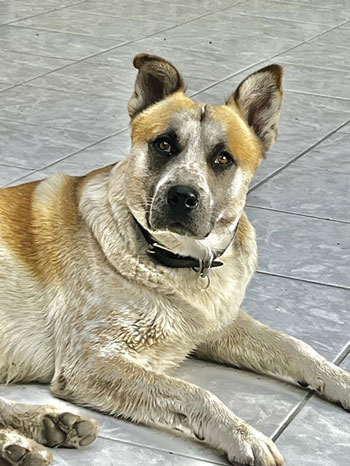
From my balcony I can see who he picks on any given day. In the early morning hours, the oddly marked dog lopes behind a couple of girls, perhaps thinking it’s a good day to check out the local school. The girls ignore him. Another morning, he chooses a young family. Only the toddler notices him.
But the expat couple he tags? A whole different story.
“I wish we could adopt him!” one said to the other. The pity and longing play side by side. This poor stray and his frustrated saviors.
Mapa is a large shepherd mix with a distinctive pattern on his back—hence his name, which is Spanish for map. He’s a genial soul who happily trails alongside people, curious to see where the day will lead him. Maybe it will be a stroll along the lake or a visit to the plaza. Maybe he’ll be invited into a home for a few hours or overnight.
Like the expat couple I watched that morning, my Canadian neighbors also misread Mapa’s go-along attitude as a desire for permanency. This dog would be theirs.
Doug stuffed his pockets with leftovers before their morning walks along the malecón, and within a week or two Mapa had parked himself in front of their tiny apartment. Steak tips and barbecued chicken outranked stale tortillas any day.
They bought an enormous leather dog bed which, they told me, Mapa only occasionally used on the evenings he decided to stay. Like some of his human counterparts who lived on the streets, Mapa found more comfort in the familiar. Soft beds and steak offered a nice change, just not nice enough for forever.
The couple did not yet know this. They moved ahead as if the deal was sealed and tempted Mapa through the doors of a local vet. First, the health checkup. Days later it was time to be neutered, then a bath, vaccinations and flea control followed in short order.
One would think Mapa drew the line when they took his testicles, but he continued to enjoy their shared walks, barbecued chicken and an occasional night’s respite from the sidewalks.
According to Doug, it was the collar and leash that did it. The fancy Mexican embroidered collar went on just fine. Mapa looked up expectantly, tail slowly wagging as the heavy leather leash was attached. Doug pulled gently. Mapa remained where he was. Doug pulled a little harder. Mapa sat. Treats were proffered. Begging turned into cajoling, then a firm command.
Mapa didn’t struggle, thrash, or make a scene because Mapa was never about drama. He—not the human—knew what he wanted.
I understood Doug’s frustration, that deep need to save someone who does not want saving. I remember sitting across from my brother during an intervention, watching him gaze disinterestedly out the window as the rest of us catalogued our concerns about his drinking. My attempts to rescue humans from themselves have gone about as well as Doug’s with Mapa.
Doug finally got the message. Mapa needed to be met on Mapa’s terms. Food and water were left at their front door and the big dog with the harlequin patchwork sometimes scratched at their door to come inside for a bit. He joined them most mornings as they strolled the malecón, but there was really too much else to do than hang around with the same two people all day. There were bones to be begged from the butcher and treats to be had from café patrons.
Mapa already has a home. Many homes, actually. Arte Coffee, Café/ina, Lely’s Ahogadas, Rod and Ashley’s casita, Susa’s apartment and El Jardin restaurant. And those are only the ones I know about.
Mapa has become everybody’s dog because he’s nobody’s dog and he prefers to keep it that way. He doesn’t want you to adopt him, to chain him to the regimented schedule that my dogs live by.
A WhatsApp group of about a dozen or so neighbors keep each other informed of Mapa’s needs. Who’s refilling the food dish this week? Is it time for his flea treatment? We post cute photos of this perro callejero commandeering a yoga mat from the outdoor exercise class, sprawled across a coffeehouse entrance, frolicking through the crowds at an outdoor music festival.
But street dogs rarely reach senior status in this—or any—town in Mexico. Although we can provide the treats, we can’t slow down the speeding cars or keep the animals from wandering through heavy traffic. We can let him know we care but, ultimately, we can’t save him.
It´s early, a sliver of gray barely crests the horizon as I enjoy my first cup of coffee on the balcony this morning. Armando trudges up the street on his way to work. Though I can’t make out his features, I recognize the music from his boombox. We call out “buenos días” to each other. Trotting close behind him is a dark shape I recognize instantly.
It’s the start to a good day.
We invite original essays of up to 700 words for Among Animals. Tell us about the creatures who share our lives—wild or domestic— and the ways they challenge, comfort, and change us. Email submissions to editorelojodellago@gmail.com with the subject line: “Among Animals.”

 Discover trusted local services and hidden gems with our easy-to-use online directory.


- Among Animals – October 2026 - September 30, 2026
- Let’s Talk About You: Why We Love to Gossip - May 31, 2025
- You Call that Music? - October 29, 2024