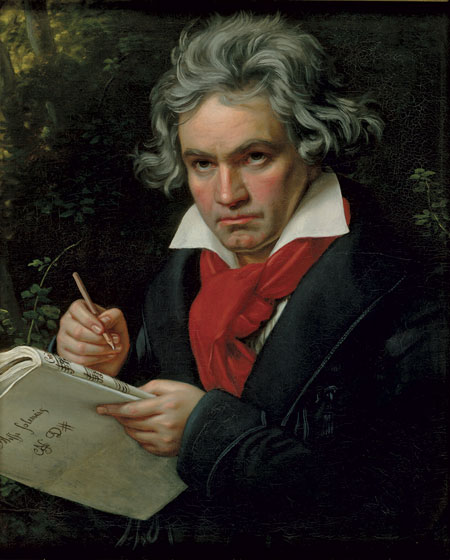
On the evening of May 7, 1824, Ludwig van Beethoven stood on the stage of Vienna’s Kärntnertor Theatre shadow conducting the premiere of his Ninth Symphony. The audience erupted in applause. Hats were thrown into the air. Handkerchiefs waved. By all accounts the ovation lasted several minutes. Yet Beethoven heard none of it.
By then he was almost completely deaf.
Unaware that the music had ended, he continued beating time until the young contralto Caroline Unger gently took him by the arm and turned him toward the audience so that he could finally see the thunderous applause he could not hear.
Every so often a work of art changes the way humanity understands itself. Beethoven’s Symphony No. 9 in D minor, Op. 125—the Choral Symphony—is one of those rare creations. It is not simply one of the greatest pieces of music ever written; it is one of the supreme achievements of human creativity.
The Ninth Symphony was the fulfillment of a dream Beethoven had carried with him for more than thirty years. As a young man he had fallen in love with Friedrich Schiller’s poem “An die Freude” (“Ode to Joy”), written in 1785 as a celebration of freedom, friendship and the brotherhood of humankind. Beethoven longed to set those words to music, making sketches for the project as early as the 1790s.
Only in 1824, after decades of thought and struggle, did he finally realize that lifelong ambition.
The result changed music forever.
The Ninth was revolutionary in almost every respect. At approximately 65 minutes it stretched the very definition of what a symphony could be. More astonishingly, Beethoven did something no major composer had dared before: after nearly 45 minutes of purely orchestral music, he introduced four vocal soloists and a full chorus. It was a breathtaking surprise. Suddenly, the orchestra was no longer enough. Human voices became necessary to express an idea too profound for instruments alone.
That idea was simple yet audacious—that despite suffering, conflict and division, humanity is capable of joy, compassion and unity.
The symphony begins in extraordinary fashion. Out of an almost empty musical landscape, faint open intervals emerge as though the music itself is slowly coming into existence. It is one of the most mysterious openings ever composed. From those whispered beginnings Beethoven constructs a musical universe of astonishing emotional range: struggle, triumph, humor, tenderness, contemplation and, ultimately, overwhelming joy.
When the final movement begins, Beethoven does something unprecedented. After a dramatic orchestral outburst, a baritone soloist rises and sings:
“O freunde, nicht diese töne!” ~ “O friends, not these sounds!”
It is as if Beethoven himself interrupts the symphony, rejecting everything that has come before in search of something greater. Moments later comes one of the most recognizable melodies ever written—the radiant theme we now know simply as the “Ode to Joy.”
Yet this joy is not superficial happiness. Beethoven’s message is far deeper. Throughout the symphony he shows us struggle before triumph, uncertainty before confidence, darkness before light. The exhilaration of the finale is so overwhelming precisely because it has been earned. Joy is not presented as the absence of suffering but as its transformation.
Perhaps that is why the Ninth continues to speak so powerfully to modern audiences.
We live in an age of endless distractions: streaming music, carefully curated playlists and an almost limitless supply of entertainment. Yet Beethoven asks something different of us. He asks us to listen—to follow a single musical journey from beginning to end and to experience its emotional and philosophical arc as one complete whole. The Ninth’s influence extends far beyond the concert hall. It has been performed at moments of celebration, remembrance and reconciliation across the world. Again and again, people have turned to Beethoven’s Ninth when searching for a musical expression of hope.
Having spent many months studying and preparing this extraordinary score for performance, I have become convinced that Beethoven’s Ninth is not merely something we hear. It is something we experience. Rehearsals always reveal another layer of its humanity, another reminder that beneath its monumental architecture lies an intensely personal work created by a man who had endured loneliness, illness and almost total silence, yet still believed in the possibility of joy.
No recording, however magnificent, can fully capture the impact of hearing this work performed live. When more than one hundred musicians and singers unite in the final chorus, the sound is not simply heard—it is felt. It is one of the few musical experiences that can genuinely leave an audience transformed.
On Saturday, October 24, the Lake Chapala Orchestra, together with a forty-voice chorus and four distinguished soloists, will present the first performance of Beethoven’s Ninth Symphony ever given in the Lake Chapala region. It promises to be a landmark event in our community’s cultural life. Details of the event and ticket purchases can be found at the orchestra’s website www.lakechapalaorch.com.
Whether this will be your first encounter with the Ninth or your 50th, I invite you to join us. Allow yourself 65 uninterrupted minutes to travel from the mysterious whispers of its opening to the blazing affirmation of its conclusion.
More than two centuries after Beethoven laid down his pen, his Ninth Symphony continues to ask the same profound question: can humanity rise above suffering and division to find common joy?
Every performance is another attempt to answer “yes.”

 Discover trusted local services and hidden gems with our easy-to-use online directory.


- The Power of Beethoven - September 30, 2026
- Magical Musical Beasts - October 30, 2024
- A Fifth of Beethoven - February 27, 2023