The Indigenous woman known as La Malinche— the enslaved interpreter who later had a child with Hernán Cortés—has long been cast in Mexico as a symbol of betrayal, her name synonymous with traitor or sellout. But who was she, really? Drawing on Indigenous accounts and recent scholarship, Noris Binet offers a far more nuanced portrait of a woman whose role in history has been both powerful and profoundly misunderstood.
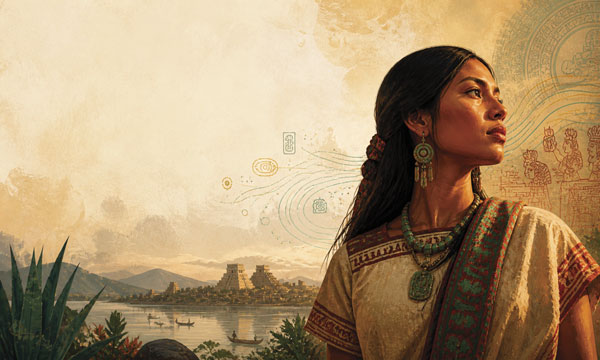
On par with the most powerful men of her time, an indispensable interpreter emerged. She was admired for her intelligence and extraordinary negotiating skills. Because the Indigenous peoples of Mexico never ceased to value her, the white patriarchy of the Criollo viceroyalty of “New Spain” tried—and failed—to portray her as a traitor. Now, at this historical moment in Mexico, Indigenous cultures are being recognized, their languages celebrated, and their heritages reclaimed. In this renewed light, she emerges as the most important figure of the conquest period. In 2025, International Translation Day (observed on September 30) was dedicated to her as the first translator of this land, and cultural events honored her true legacy.
At the beginning of the 16th century, Mexico-Tenochtitlan (now Mexico City) flourished as the center of the Aztec Empire under the Triple Alliance of the Mexica, Texcoco, and Tlacopan. To the southeast lived the Maya and other less powerful peoples, such as the Totonacs, many of whom were subjugated by the Aztecs.
Malinalli was born around 1500 in what is now Veracruz, in southeastern Mexico. Little is known of her childhood, though she is believed to have been the daughter of a nobleman. Around the age of 12, she lost both her freedom and her innocence, becoming enslaved. She spoke her native language as well as Nahuatl, the official language of the Aztec Empire. Later, she was given as tribute to a Mayan chieftain in Tabasco, where she learned the Yucatec Maya language.
Historical records show that in 1519 she was one of the twenty women given to Hernán Cortés as slaves by the Tabascans after their defeat at the Battle of Centla. Cortés distributed most of the women among his men, who treated them as objects for their own sexual desires. Perhaps because of her beauty and poise, he gave Malinalli to his Spanish right-hand man, whom he had brought with him to Mexico. It was then that Malinalli was baptized with the name Marina.
Moctezuma, ruler of the Aztecs, learned of the foreign ships off the coast and sent delegations bearing gifts to dissuade the invaders from advancing farther. These emissaries spoke only Nahuatl, so Cortés’s interpreter, who spoke Spanish and Maya, could not understand them. Malinalli seized the opportunity and quickly began translating from Nahuatl into Maya, thus solving the problem.
From that moment on, she began to play a very important role and gradually became known as Malintzin, a title bestowed upon her by her own culture. The suffix -tzin, a mark of distinction, means venerable or respected. She was venerated not only as the Spaniards’ interpreter, but also for helping forge alliances among the peoples living under Aztec dominion, effectively facilitating what was, in reality, a civil war that led to the defeat of the empire. Those who sought to free themselves from the oppressor formed alliances with Cortés, with Malintzin as the key facilitator, further establishing her as an exceptional negotiator.
Finally, when Cortés and Moctezuma met, perhaps the most surprising sight was the presence of a woman among all the men, looking directly into the eyes of the Aztec ruler—a gesture traditionally forbidden—and speaking on behalf of the foreign leader who commanded a powerful army. Even the Spaniards present remarked on the mastery with which Malintzin mediated between these two powerful men, to the benefit of both the Indigenous allies and the Spaniards.
At every turn, we watch Malinalli find ways not only to survive but to triumph. For me, she represents the archetype of the heroic feminine. Even while enslaved and subjugated, she intuitively and intelligently becomes the vital link of communication and interpretation between two competing civilizations.
Indigenous sources recount that Malintzin, in certain moments of tension, tried to calm the people by explaining that even if they fought, the Spanish would simply bring more men and the violence would escalate. Instead, she urged them to negotiate and form alliances that would benefit their people. This is why Malintzin appears in some codices almost as a goddess, embodying the power of speech, translation and the written word. Her memory remained deeply ingrained among the Tlaxcalans, who represented her as a prominent presence in their historical record.
The fall of Tenochtitlan—and with it, the collapse of the Aztec Empire—marked the beginning of a new cycle, a reorganization of power in which Malintzin played an important role as interpreter during the reconstruction. She also occupied a central place in the household she shared with Cortés in Coyoacán. She was not only his interpreter, but also the woman with whom he had a sexual relationship. She collaborated by receiving Indigenous delegations and assisting in the many negotiations with the Spanish. This greatly increased her renown in both cultures, and she frequently received gifts of copal, fruit, and tobacco as tokens of gratitude.
Living in her own house, Doña Marina (a respectful title) gave birth to a son, Martín, who was said to be Cortés’s favorite among his many children, born to his wife and several other partners. But Malintzin soon had to leave on another expedition with Cortés, where her status would change radically. She was married to Juan Jaramillo, one of Cortés’s most important and noble captains, thus ceasing to be enslaved and gaining rights comparable to those of other Spaniards.
By this time, she had established significant relationships with many Spaniards and served as the official translator. This allowed her to learn what she needed to do to protect her position, obtain legal rights, secure her son’s future, and become a free woman.
Furthermore, she asked Cortés for a wedding gift and became the fourth person to receive an encomienda, a grant of land and tribute rights. She requested Oluta, her homeland, so that she could govern it and protect its inhabitants.
They continued their journey, eventually reaching Cuba, where Malintzin gave birth to a daughter who was born free. The child later died in an epidemic.
Malintzin’s life may not have begun so brutally, as she appears to have been the daughter of a nobleman and likely learned something fundamental from her lineage. Much like the heroines of certain fairy tales, she may have been born into circumstances that taught her essential lessons—lessons that later helped her navigate a world of injustice and suffering.
For example, her birth name, Malinalli, means the perennial grass used to make rope. And what was she, if not a rope stretched between two worlds, two peoples, two cultures, and two empires pulling against one another? Yet those forces were also interconnected. She was the rope, the energy, and the interpreter among different language groups that needed to communicate.
Her life was spent walking from place to place, accompanying Hernán Cortés, never riding a horse. But we can be sure that her deepest pain came when Cortés took their son and sent him to Spain to be recognized as his descendant. Here, too, lies the birth of mestizaje, or mestizos, the beginning of racial and cultural mixing.
It is not known exactly when she died, but it was likely sometime between 1528 and 1530. Indigenous records cease to mention her after about 1530. After the conquest, she largely fell into oblivion, as patriarchal historical sources rendered women invisible and erased their roles. In Spanish writings, she appears only in a few scattered references. Yet almost everyone respected her, with two notable exceptions: López de Gómara, who refers to her only as the Indigenous woman with whom Hernán Cortés had his son Martín, and Jerónimo de Aguilar, whom Malintzin replaced as interpreter once she learned Spanish.
Were it not for the Indigenous records that preserve her presence, we would know almost nothing of her. In them, she appears as an important and fundamental figure, often painted higher than Moctezuma and Cortés. Her prominence rests on the force of her eloquence.

 Discover trusted local services and hidden gems with our easy-to-use online directory.

- From Myth to History: Restoring Malinalli - May 30, 2026
- La Virgen de Guadalupe: The Goddess of the People - November 30, 2025
- Recovering the Sacred Feminine: - July 29, 2025