
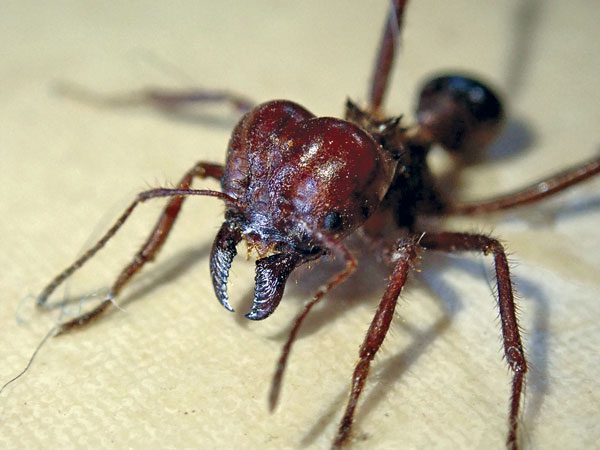
We tend to think of agriculture in human terms. But when our ancestors began rudimentary farming about 12,000 years ago, leafcutter ants were millions of years ahead of us.
Surprisingly, their story began some 66 million years ago, when an asteroid believed to be about 10 kilometers wide slammed into the Yucatán Peninsula. The Chicxulub asteroid ejected massive amounts of vaporized rock and dust into the atmosphere, blotting out the sun and causing an “impact winter” that lasted for several years. Photosynthesis shut down, resulting in an estimated loss of 75% of all species at the time.
With an abundance of dead and decaying plants, decomposers such as fungi thrived. This spelled opportunity for fungus eaters, including the eusocial ancestors of today’s leafcutter ants, who abandoned their hunting-and-gathering lifestyle in favor of primitive fungus farming.
For millions of years, the ants’ farming techniques were casual. However, a second major geological event forced a huge paradigm shift in their farming technology.
Around 27 million years ago, a global cooling event brought about the seasonally dry climate in South and Central America that we are familiar with today. To sustain their preferred moisture-loving fungi, the fungus-farming (a.k.a. attine) ants adapted by moving their farming operations underground. Over time, their subterranean farms became increasingly massive and complex.
With the fungi now isolated, the ants and their fungal crops began to co-evolve in lockstep. Eventually, their codependent relationship evolved into an “obligate symbiosis.” Literally, the ants and their mutualistic fungi can no longer survive without each other.
This origin story has been corroborated by a recent phylogenetic study published in the October 2024 edition of Science, entitled The Coevolution of Fungus-Ant Agriculture. The study showed that farming ants split from their non-farming relatives around the time of the asteroid impact and that leafcutter ants later evolved together with the fungi they cultivate after the planet cooled.
In the Lakeside area, you may see Mexican leafcutter (Atta mexicana) worker ants carrying large leaf clippings or berries atop their oversized heads. Over years of dependency on fungus, the ants have lost the ability to digest leaves directly, so they let the fungus do that for them. The ants carry clippings into their underground fungus gardens and chew the leaves to create compost for growing their fungal crops. Essentially, the fungus farms can be thought of as an enormous external digestive system for the ant colony.
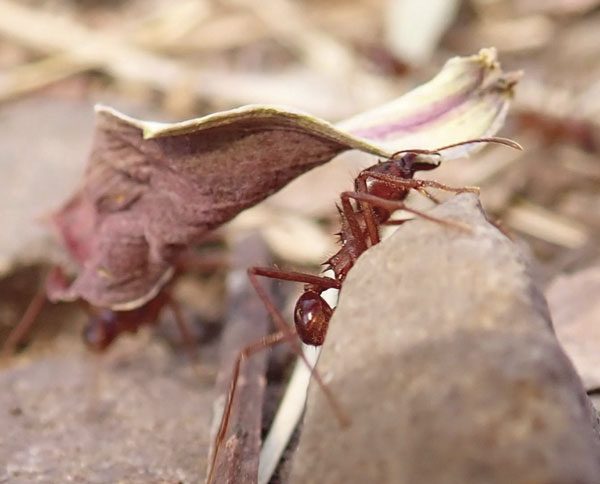
Like the biome in our own digestive systems, the ants’ fungus gardens contain microbes essential to the survival of the colony. The ants unknowingly carry bacteria on their bellies that produce antibiotics, protecting the colony from deadly parasitic microfungi. There are also “nitrogen-fixing” (diazotroph) bacteria that fertilize the soil in the fungus gardens. These bacteria take in nitrogen from the atmosphere and convert it to ammonia, making the nitrogen available to their fungus crops. As an added benefit, this also releases nitrogen into the surrounding ecosystem.
The underground nests of leafcutter colonies can be enormous, covering as much as 600 square meters and containing as many as 8 million ants. Leafcutter ants are born into four distinct castes of varying sizes and shapes, each with a designated role. Since the ants, their cultivated fungi, and their mutualistic bacteria all work together, the entire colony functions like one living system — a multi-species “superorganism,” or holobiont.
The leafcutter ants seen throughout most of the year are exclusively female. However, early in the rainy season each year (usually in early July), you may see swarms of both male and female winged leafcutter ants (alates) taking part in an annual, multi-day midair mating ritual loosely referred to as “Flying Ant Day.” The female queen candidates carry a small chunk of fungus in their mouths as a sort of “colony starter kit.” The females mate with as many partners as they can, saving enough sperm to last a lifetime underground. When they find a suitable spot, they chew off their wings, dig a small underground nest, and begin cultivating their fungus. The male participants die off a few days after mating, having had the pleasure of helping to expand their colony.
As local garden enthusiasts are aware, a colony of leafcutter ants can decimate the leaves of a moderately sized tree or bush overnight. As demoralizing as this might be, it may be some consolation to consider the many benefits of having leafcutter ants working our soil. Our gardens might not be as lush and vibrant without the nitrogen-rich fertilization provided by the ants’ helpful bacteria. The ants act as “nature’s rototillers” (or bioturbators), aerating and mixing the soil and allowing water to reach deep roots more effectively. By harvesting leaves from a wide variety of plants, they also help maintain biodiversity and promote ecological balance. Finally, their origin story reminds us that in times of upheaval and massive disruption, opportunities arise for those who are adaptable, persistent, and perhaps a bit lucky.

 Discover trusted local services and hidden gems with our easy-to-use online directory.


- The Cataclysmic Origin Story of Leafcutter Ants - March 31, 2026
- Listening to the Eyes of a Butterfly - August 30, 2025