“The most beautiful thing we can experience is the mysterious…He who can no longer pause to wonder and stand wrapped in awe is as good as dead – his eyes are closed.” ~Albert Einstein
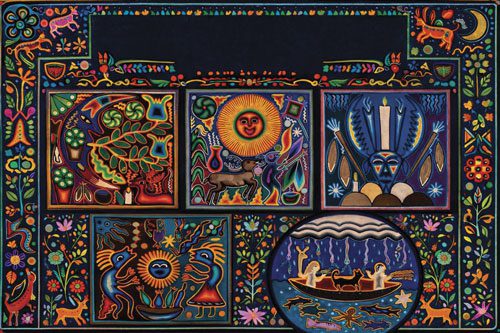
How easy it is to stumble through life, eyes half closed, oblivious to the magic surrounding us, if not as good as dead, perhaps only half alive. We take things we see every day for granted, like the magnificent Indian laurel tree my neighbors cut down last month, or treasures like the three pieces of folk artwork hung in my study. A wake-up call can take many forms, the sounds of chain saws cutting down one’s favorite tree or the discovery of a small book titled Yarn Paintings of the Huichol in a secondhand bookshop.
I own five of these yarn paintings. They are vivid in color and rich in symbolism, yet I had never asked what they meant or who created them. It’s not that I don’t like them, I do, but they became familiar decorations. I hung them up and more or less forgot about them.
While the book uses the term “Huichol,” the people are today more properly called the Wixárika, the name they use for themselves. I learned from the book yarn paintings are a visual prayer to the gods and symbolize what is seen through a shamanic vision. They are doorways to the world beyond. The book goes into great detail about the symbolism behind many of the common themes in yarn painting. This newfound knowledge fresh in my mind, I took two of the paintings down from the wall and turned them over. To my astonishment, there was writing on them, explanations of what the artists wanted to convey. Not only that, they were signed!
Portrait of Kauyumarie depicts the blue deer god with a large candle atop his head. I understand that candles can represent the life of a person, perhaps the artist himself. Beneath the deer are five rocks that indicate the sacred sites of the five cardinal directions (north, south, east, west and center) as described in the legend of Kauyumarie in which he created the animals by making paintings. When he finished, his depictions came to life, and the animals came to be. My painting is signed by Rogelio Herandez Robles from Tepic; in his own handwriting he says his painting explains how the face of the blue deer connects mankind to the gods.
Benediction by Rogelio Diaz Medina shows a female shaman participating in a religious ceremony. On the left, which is black and represents nighttime, another shaman sends messages skyward. The female shaman stands to the right on a green background, which may indicate life. In the center is the sun god, Our Father Tayeu. Below him is a ceremonial bowl containing offerings to him, ears of corn and a candle. Small yellow discs are scattered across the painting, which may be mirrors or visions or eyes that see!
The circular yarn painting I bought, which I’ve named Voyage, is signed by Maria Hernandez and dated September 28, 2006. The artist did not write on it, and I assume it was created specifically for sale. It may show a Wixárika myth rather than be a personal vision – I just don’t know. On it, a man and a woman ride across a lake in a boat, accompanied by a black dog. It is storming, rain in the guise of serpents falls from a dark cloud. Below are sea creatures, including a turtle and an octopus. Perhaps the body of water is Laguna Santa Maria del Oro which is sacred to the Wixárika and which I have been fortunate enough to visit.
My eyes beginning to open to the mysteries crafted into these yarn paintings, my husband and I made a pilgrimage into our own village of Ajijic. It was September 20, 2025, the occasion of our fortieth wedding anniversary, and we were in a celebratory mood. Lo and behold, we found a new shop on the main street: Wixárika. In we went, and there it was, a yarn painting that spoke to me immediately. It depicts a traditional ceremony with a worshipper offering up the blood of a deer to the sun god. He is praying for the health of his family. The artist is Pedro Bautista Cervantes.
We returned to the Wixárika store at Christmas time. The painting I had hoped to purchase was sold, but I swallowed my disappointment and bought Luna instead. The artist didn’t sign their work, but they did write a message in pencil on the back, explaining that the moon is sacred and their work shows offerings being made to the lunar goddess. I thank this unknown artist and all their peers who share their religious beliefs with such skill and create such beauty. These works have helped open my eyes to the wonders they see all around us.

 Discover trusted local services and hidden gems with our easy-to-use online directory.

- Wixárika Yarn Paintings - March 28, 2026
- PROFILE – Elly Contreras - December 30, 2025
- Harry Bublin – A Profile - October 30, 2025