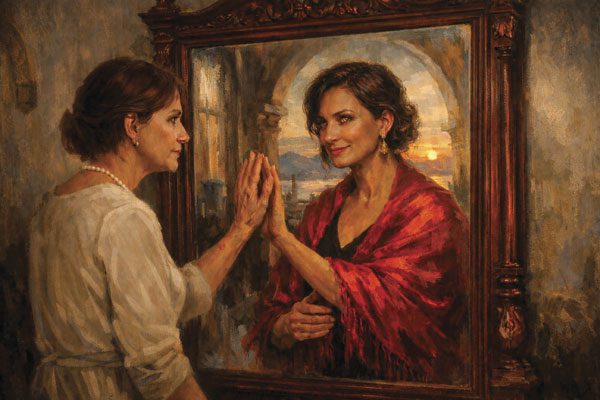

Death came closer today. She does not arrive on little cat feet like Carl Sandberg’s fog, though she can easily sneak up on a person. Mostly, she arrives when you have a pain that won’t go away, find a lump that wasn’t there the day before, or forget your most important memory. She’ll walk behind you for years or months until one day she looks at her watch and says, “Your time has come.” She then moves beside you, takes your hand, and whisks you away to the next place, wherever you believe that to be.
I’ve managed to stay out of her sights for 75 years, but that’s not the case for many of my loved ones. Last year, seven of them died: 67, 68, 77, 87, 88, and 92. Today Death gently lifted my 85-year-old brother out of this life. For the last month, he lay in a hospital bed six inches away from his wife of 64 years holding hands with her. Both live — or do I now write lived? — in a contemporary continuous care community in Florida that looks like a hotel resort from the outside.
I arranged a family reunion eight months ago and saw them for the first time since our 82-year-old sister’s funeral in 2017. At that time, they were aging in the home they’d lived in for over 25 years, 150 miles away from their nearest child, a son. She had been diagnosed with dementia two years earlier and was showing clear signs of memory loss. She suffered from hallucinations and delusions. I labeled her “delicate not frail,” but two months later, she fell and crossed over into frailty after a hospital stay.
That was the turning point necessitating a move to a memory care community. She did not like the change or the facility. My brother found it so depressing he would only visit her in her room and avoided the common areas, like the dining room, where dementia’s ravages were most evident.
Hard decisions had to be made. The house was sold, which in my mind should have happened sooner, before he learned what caregiver burnout meant, before she became unable to decide what to keep and what she loved most. By the end, my brother and his three sons packed up closets of their mother’s clothes, dressers full of more, and sorted through boxes of memorabilia. My brother wanted to throw it all out, to cut all the connections to that happy place where he had reigned. The sons let him, except for a very few sentimental pieces that touched them.
My brother and his wife moved 150 miles nearer to their youngest son, who is 61, into an elegant and expensive continuous-care community. She landed in memory care, and he eased into a life that included three meals a day, laundry, and housekeeping. While accepting what they could not change, they were not happy about it. He found visiting her in memory care to be emotionally painful, yet he walked from his independent living quarters to her locked unit three times a day.
She fell again. And then again. The third fall fractured a hip. With no reasonable repair to be done, she became, in a moment, bedbound. Her confusion escalated and her memory slipped more. She was admitted into hospice care.
A few weeks later, he became ill and was sent to the emergency room, where tests revealed that a rare and terminal blood disease had bloomed in his bone marrow. I thought he was the luckier of the two. The son who had power of attorney for medical decisions, got around to documenting a Do Not Resuscitate order, No Tube Feeding, and No medical treatment that will only prolong death rather than improve his quality of life. It was a compassionate order to let my brother die naturally, as he wanted.
My sister-in-law wondered where he was during the longest separation of their entire marriage. When he was discharged and returned to his apartment, hospice had a hospital bed waiting. Within an hour, she was wheeled through the corridors in her hospital bed. As soon as the beds were placed side by side, they reached across the narrow space and held hands. They were holding hands when he died today.
I love/loved my big brother, but I did not know him well. He is/was ten years older. I had a career and am child-free. He and his wife migrated far south from Chicago after their third child was born and before their fourth. It’s hard to travel with four small children, so they only returned for weddings and funerals. They were threads in the tapestry of my life, but there are many more threads, in much brighter colors, more tightly woven together.
Nonetheless, he’s my only brother. Our older sister, my best friend, died eight years ago. Now I am the oldest living member of our family. That awareness feels more uncomfortable than learning my brother died today. He didn’t want a funeral or memorial service. No friends were left to attend. He did not see how this decision deprived his children and grandchildren of the opportunity to mourn his loss with their friends, to spread their grief across many shoulders, to teach others how to heal their wound.
His death has elevated me to the eldest in our family, a throne I was not prepared to ascend quite yet. But ascend I must, because I am the eldest. From that throne, I plan to reign with compassion, gratitude, and joy, as an example to those who must climb the steps to elderhood after me. I will sit there until the day I go from is to was.

 Discover trusted local services and hidden gems with our easy-to-use online directory.


- From Is to Was: January 6, 2025 - February 28, 2026
- It Happens - November 30, 2025
- It Happens - October 30, 2025