
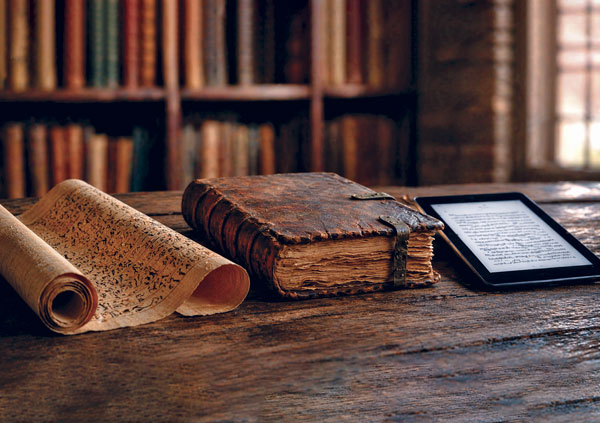
How the Materials We Write on Shape the Rise and Fall of Knowledge
The story of Western civilization goes something like this: Egypt, Greece, Rome, the Dark Ages, the Renaissance, the Enlightenment, the Industrial Revolution. Along the way writing spreads, literacy grows, knowledge accumulates, and humanity gradually learns more about the world and how to live in it.
Except for one puzzling interruption.
After the fall of Rome, Europe seemed to stall. For roughly five centuries, the so-called Dark Ages, life for most people became harsher and knowledge spread slowly. Literacy shrank to a narrow world of monasteries where monks copied religious texts and a handful of classical works. What happened?
Historians point to wars, political collapse, and social upheaval. But there may be another, more practical explanation hiding in plain sight: writing requires something to write on.
Seen this way, Western civilization might be divided into three overlapping eras: the Age of Papyrus, the Age of Parchment, and the Age of Paper.
The Age of Papyrus
Papyrus, made from reeds growing along the Nile, was the ancient world’s first widely available writing surface. Strips of the plant were layered, pressed, and dried into sheets that took ink beautifully and held up well.
Fragments survive from more than 4,500 years ago — records concerning the quarrying of limestone for the pyramids. Bureaucracy, it seems, was already thriving.
Because Egypt exported grain across the Mediterranean, ships that carried wheat from Alexandria to Greece and Rome often carried papyrus as well. The result was a wide circulation of written material throughout the Roman world: government documents, histories, scientific treatises, poetry, plays and even porn. Strangely, among the most accomplishedly literate were the slaves—scribes—who made the copies that were sold in shops, could be borrowed at libraries, and graced every well-appointed home.
For centuries Rome maintained stable trade with Egypt, ensuring that papyrus continued to flow across the Mediterranean and supporting the written culture of the classical world.
The Age of Parchment
Papyrus had one weakness: it depended entirely on Egypt. This supply chain monopoly revealed itself in 191 BCE, when two great cultural centers were vying to have the largest and most complete library: Alexandria in Egypt and Pergamon in what is now Turkey. Egyptian pharaoh, Ptolemy V, definitely not playing fair, blocked the export of papyrus. Pergamon was forced to use some other writing surface so it could continue expanding the library. It turned to parchment. The word “parchment” comes from the Latin for Pergamon.
However, as Rome’s control over Egypt grew, that was only a brief setback for papyrus. The writing surface, the books written on it, and the ability to read them, were found all over the empire for centuries—until 642CE when the Arabs conquered Egypt and brought the Age of Papyrus to a close.
Parchment was durable but expensive. Producing it required raising animals, preparing their skins, and carefully scraping each sheet. One animal skin might yield only a few usable pages. A large Bible could require the hides of hundreds of animals. Books became rare and costly objects.
Imagine Cuthbert, a clever fellow living in a village in Wales, who invented a better fireplace to warm his smoky home. Today he might write a pamphlet or post a video explaining the design. In the year 1000, however, there was no cheap material on which to spread such an idea. Parchment was far too valuable for everyday writing. Without abundant writing material, the sharing of ideas slowed dramatically.
The Age of Paper
Meanwhile, far to the east, another invention had already appeared. In China, papermakers discovered that plant fibers could be pulped and spread into thin sheets, a lightweight writing surface far cheaper than parchment.
Papermaking spread westward along trade routes and through Islamic lands, where scholars quickly adopted the new material. As paper traveled with the expansion of Arab civilization, it helped support what historians now call the Islamic Golden Age, when scholars produced influential works in mathematics, astronomy, medicine, and philosophy.
By the twelfth century paper mills appeared in Islamic Spain, and from there the technology spread across Europe. Then came another transformative invention: Johannes Gutenberg’s printing press in the 1440s.
Printing on inexpensive paper changed everything. Books could now be produced quickly and in large numbers. Bibles, prayer books, almanacs, scientific treatises, practical manuals and porn poured from presses across Europe. The Bible quickly became the early printing industry’s most reliable bestseller, helping sustain the production of other books.
It became worthwhile to read because there were interesting things to read, as there had been in the Age of Papyrus. Literature, science, and commerce bloomed. Papyrus-recorded knowledge was rediscovered: Socrates, Euripides, Archimedes, Hippocrates. There followed the Renaissance, the Enlightenment, the modern age.
A New Age?
Have we stuck a toe into a new age that comes after the Age of Paper? Should there be cautions that come with exchanging and storing information using electrons and orbiting satellites and undersea cables and…clouds? Will solar flares remain as modest as they have been during humans’ brief coexistence with our star? A big enough solar burp could wipe out every electronic device we have. Perhaps we should take warning from the interrupted sweep of knowledge that the Age of Parchment taught us can happen.

 Discover trusted local services and hidden gems with our easy-to-use online directory.


- Profile: Diane Pearl - August 29, 2026
- Profile: Dave Mcintosh - May 30, 2026
- From Papyrus to the Cloud - April 29, 2026